

Table of Contents
- Why a Commercial Water Heater Maintenance Schedule Pays for Itself
- Commercial Water Heater Inspection Frequency: Daily, Monthly, Quarterly, and Annual Tasks
- The Commercial Plumbing Maintenance Checklist Every Facility Manager Needs
- The Commercial Water Heater Flushing Procedure, Step by Step
- Anode Rod, T&P Valve, and Thermostat: The Parts That Decide Uptime
- Gas, Electrical, and Venting Checks: What Only a Licensed Technician Should Touch
- Leak Detection, Error Codes, and Compliance: Catching Problems Before They Shut You Down
- Frequently Asked Questions
Last Updated: September 27, 2026
Why a Commercial Water Heater Maintenance Schedule Pays for Itself
A commercial water heater maintenance schedule is a documented plan of daily, monthly, quarterly, and annual tasks that keep a commercial hot water system running at its rated thermal efficiency. A failed heater shuts down showers, dishwashers, and production lines until someone fixes it.
The ROI of Preventive Maintenance: Energy Efficiency and System Longevity
Sediment buildup is the quiet thief here. Scale on the tank floor and heating elements forces the burner or element to run longer for the same hot water output, dragging thermal efficiency down month after month. A planned flushing routine restores heat transfer and extends system longevity. The payback isn’t a brochure number; it’s the avoided emergency call, the avoided early replacement, and the smaller utility bill.
Commercial vs. Residential Water Heaters: Why the Stakes Are Higher
Commercial-grade units run hotter, cycle far more often, and serve multiple fixtures at once, so sediment, corrosion control, and venting all matter more. A residential tank can limp along between service visits; a commercial system serving a restaurant or warehouse cannot. The same task that takes twenty minutes at home can prevent a full-day outage on site.
Skipping the annual flush on a hard water supply is a common mistake. The scale that builds up insulates the heating surface, so the unit works harder for the same result and eventually fails under the added stress.
Commercial Water Heater Inspection Frequency: Daily, Monthly, Quarterly, and Annual Tasks
The right commercial water heater inspection frequency splits tasks by how fast problems develop: daily checks catch leaks and error codes, while annual service handles internals only a licensed technician should touch.
| Frequency | Task | Who Does It |
|---|---|---|
| Daily | Visual leak check, error code scan, pressure gauge reading | On-site staff |
| Monthly | Temperature setting check, T&P valve test, log update | On-site staff |
| Quarterly | Anode rod inspection, burner and pilot assembly check | Licensed technician |
| Annual | Full flush, descaling, heating element and continuity test | Licensed technician |
The Commercial Plumbing Maintenance Checklist Every Facility Manager Needs
A commercial plumbing maintenance checklist turns good intentions into a repeatable routine. Print it, assign owners, and file the completed copy.
- Inspect the tank base and fittings for moisture or rust streaks
- Record the pressure gauge and temperature setting
- Test the T&P relief valve and note any drip
- Check the anode rod for wear
- Inspect the gas supply line, manifold, and combustion chamber
- Verify the venting system is clear and properly connected
- Test heating elements for electrical continuity
- Log every reading and any corrective action taken
Logging and Documentation: Your Maintenance Log and Service Contract
A maintenance log is your paper trail. It shows a regulator or insurer that the system has been serviced, and it helps a technician spot a slow decline before it becomes a failure. Pair the log with a service contract so quarterly and annual visits are scheduled automatically rather than remembered in a crisis. For facilities in Ontario, keep records that align with Technical Standards and Safety Authority guidance on fuel-burning equipment, since gas-fired heaters fall under provincial oversight.
The Commercial Water Heater Flushing Procedure, Step by Step
The commercial water heater flushing procedure removes sediment that settles at the bottom of the tank, the highest-value task on the entire schedule.
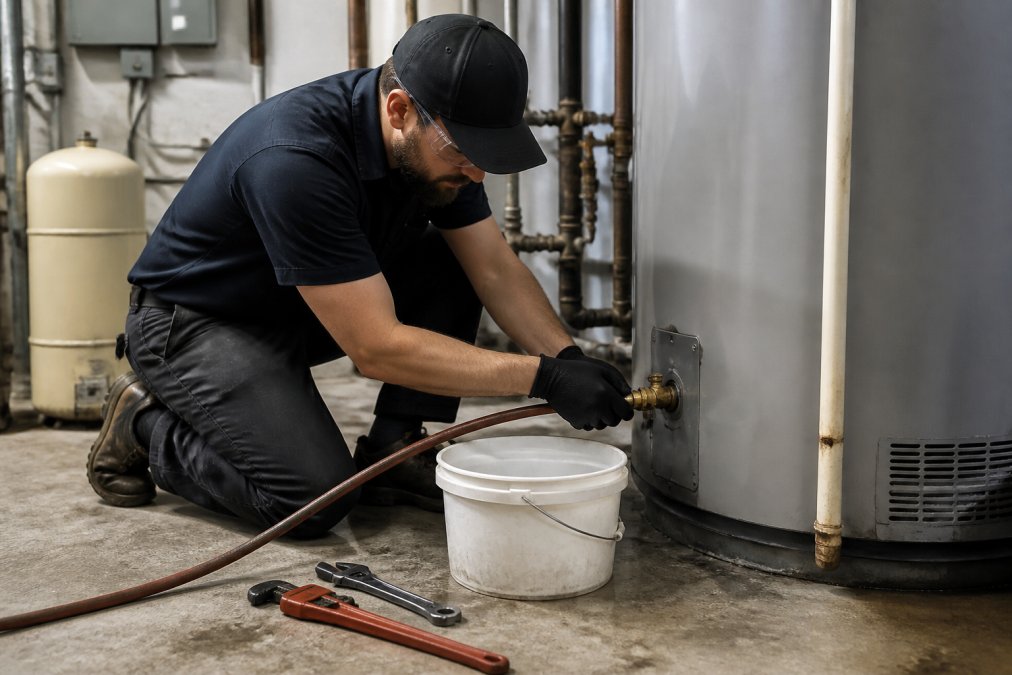
- Shut off the power or gas supply and let the tank cool.
- Close the cold water inlet valve.
- Connect a hose to the drain valve and run it to a floor drain.
- Open the drain valve and let the tank empty.
- Open the cold inlet briefly to stir and flush out remaining sediment.
- Close the drain valve, refill the tank, and restore the supply.
- Check the pressure gauge and temperature setting before returning the unit to service.
Anode Rod, T&P Valve, and Thermostat: The Parts That Decide Uptime
Three components decide whether a commercial system stays online: the sacrificial anode, the temperature and pressure (T&P) relief valve, and the thermostat. Each fails differently, on a different timeline, and needs its own inspection method. Treating them as one checklist line item is how facilities replace a tank that should have lasted another decade.
Anode Rod: The Cheapest Part You Will Ever Replace
The anode rod is a sacrificial metal core, usually magnesium or aluminum, that corrodes in place of the steel tank lining. Once consumed, the tank itself becomes the anode and rusts from the inside out, with no visible warning until a leak appears.
- Inspection interval: Quarterly for commercial units on municipal water; monthly where water is known to be soft or high in chlorides, both of which accelerate consumption.
- Pass/fail criteria: Pull the rod and look at the core wire. If more than about half the sacrificial metal is gone, or if the core wire is exposed along most of its length, replace it. A rod coated in white calcium crust but still thick is fine, that is normal passivation.
- Mechanism to understand: A segmented or powered anode rod is often the right upgrade where the standard rod is consumed in under a year. The trade-off is higher upfront cost against a tank replacement that runs into the thousands.
T&P Relief Valve: The One Part You Cannot Defer
The T&P valve is a safety device, not a convenience. It opens when tank temperature exceeds roughly 99°C or pressure exceeds the valve’s rating, typically 150 psi on most commercial tanks. Stuck shut, the tank can rupture; weeping constantly, it usually signals a thermal expansion problem, not a bad valve.
- Test interval: Monthly, by lifting the test lever and letting it snap back. You should hear water discharge into the drain line and the valve should reseat without dripping.
- Common mistake: Replacing a weeping T&P valve without checking the thermal expansion tank or incoming pressure-reducing valve. The new valve will weep too, because the root cause was never the valve.
- Replacement interval: Most manufacturers recommend replacing the T&P valve every three to five years regardless of test results, because mineral deposits can fuse the seat over time.
Thermostat: Where Energy Waste Hides
A drifting thermostat is invisible on a utility bill until you compare month over month. On a commercial tank, the setpoint is typically 60°C for storage to control Legionella risk, with a mixing valve downstream bringing delivery temperature to a safe 49°C at the fixture.
- Verification method: Do not trust the dial. Measure actual outlet temperature with a calibrated thermometer at the nearest fixture and compare it to the setpoint. A variance of more than about 3°C means the thermostat or its sensing bulb needs attention.
- Mechanism to understand: On gas units, a failing thermocouple or thermopile can mimic a thermostat problem, the burner short-cycles and the setpoint never holds. On electric units, a failed upper element or tripped high-limit switch produces the same symptom. Diagnose the cause before replacing the thermostat.
- Trade-off: Lowering the setpoint saves energy but increases Legionella risk in stored water. The correct answer for most commercial facilities is to keep storage hot and use a mixing valve at the point of use, not to drop the tank temperature.
The anode rod is the cheapest part on the system and the one that most often gets ignored. Replacing it on schedule is far less expensive than replacing the tank, and on a commercial unit, the tank replacement also means a shutdown.
Gas, Electrical, and Venting Checks: What Only a Licensed Technician Should Touch
Gas supply line checks, combustion chamber inspection, venting system verification, and electrical continuity testing belong to a licensed technician. A blocked vent or a cracked combustion chamber can produce carbon monoxide, and faulty electrical work risks shock or fire. In Ontario, gas work is regulated, and Ontario’s Technical Safety and Safety Authority sets the requirements technicians must meet. Do not let untrained staff open a gas manifold or test heating elements.
Leak Detection, Error Codes, and Compliance: Catching Problems Before They Shut You Down
Leak detection and error code troubleshooting are where a maintenance log earns its keep. A slow drip at a fitting, a recurring error code, or a high pressure gauge all point to a problem that will grow. Most guides skip what to actually do with the code once you see it, and which records a regulator or insurer will ask for.
Reading Commercial Error Codes Without Guessing
Most commercial controllers display a fault code on the display board or a remote panel. The code is a starting point, not a diagnosis: the same code can have different root causes on a gas versus electric unit, and clearing it without recording it destroys the only evidence your technician has.
| Code family | Typical trigger | First thing to check |
|---|---|---|
| Ignition / flame failure | Burner lit then dropped, or never lit | Gas supply valve position, flame sensor condition, venting blockage |
| High limit / over-temperature | Tank exceeded safe setpoint | Thermostat calibration, high-limit switch, scale on the heat exchanger |
| Pressure / expansion | System pressure above relief threshold | Thermal expansion tank charge, incoming pressure-reducing valve |
| Sensor / probe fault | Controller lost a temperature or level signal | Wiring at the probe, probe resistance, controller terminal corrosion |
| Element / current fault | Electric unit drawing no current or unbalanced current | Element continuity, contactor, breaker, wiring connections |
Leak Detection: Where to Look and What It Means
Leaks on a commercial water heater rarely start at the tank shell. They start at the fittings, T&P discharge line, drain valve, dielectric unions, and recirculation pump seals. A puddle under the unit is the last symptom, not the first.
- Check the T&P discharge line monthly. If it is wet and no one tested the valve, the valve is weeping, which points to thermal expansion or over-pressure, not a bad valve.
- Check the drain valve and hose bib. A slow drip here corrodes the tank base and the floor beneath it. This is the most common cause of a rusted tank bottom.
- Check the recirculation pump. On commercial systems with a hot water loop, a failing pump seal drips onto the floor and the pump short-cycles, driving up energy use.
- Check the flue and vent connectors for condensation streaks. Moisture on the outside of a flue pipe means the vent is not drafting correctly, which is a combustion safety issue, not a plumbing nuisance.
Compliance and Records: What a Regulator or Insurer Will Ask For
Commercial water heating sits at the intersection of gas safety, electrical safety, and building code. Your records are the proof the system has been maintained to the applicable standard.
- Gas-fired equipment: In Ontario, fuel-burning equipment falls under the Technical Standards and Safety Authority (TSSA). Keep records that align with TSSA guidance on fuel-burning equipment, including the date of each inspection, the technician’s certification, and any corrective work performed.
- Electrical work: Electrical inspections and permits fall under the Electrical Safety Authority (ESA) in Ontario. Any work on heating elements, contactors, or control wiring should be documented with the permit or inspection record.
- Building and fire code: Venting, combustion air, and clearance-to-combustible requirements are enforced through the provincial building code and local fire services. A blocked or improperly sloped vent is a code violation, not just a performance problem.
- Insurer requirements: Most commercial property policies require documented preventive maintenance on pressure vessels and fuel-burning equipment. A missing log can become a coverage dispute after a loss.
Photograph the pressure gauge and controller display on every monthly check. When a technician arrives, a dated photo of a rising pressure reading tells the story faster than a written note, and it becomes part of the compliance record.
Frequently Asked Questions
What is the average lifespan of a commercial water heater?
Most commercial water heaters last 8 to 12 years, but that range depends heavily on water quality and how consistently the unit is serviced. Hard water speeds up scale accumulation inside the tank, and neglected anode rods let corrosion start early. Facilities that follow a commercial water heater maintenance schedule, including annual flushing and anode checks, regularly reach the top of that range. Tankless and high-efficiency condensing units can run longer when combustion and venting components are cleaned on time.
What regular maintenance should be done on a water heater?
At minimum: test the T&P relief valve, check the thermostat setting, inspect the anode rod, and look for leaks around fittings and the gas supply line. Annually, flush the tank to remove sediment buildup, verify the venting system and combustion chamber on gas units, and check heating elements and electrical continuity on electric models. Document everything in a maintenance log so you can spot trends, like rising recovery times, before they turn into a failure.
Is it necessary to flush a commercial water heater annually?
Annual flushing is the standard recommendation for most commercial units, but frequency should match your water quality. In areas with hard water, sediment can build up faster, so some facilities flush every six months. Skipping it lets scale accumulate on the bottom of the tank, which reduces thermal efficiency, raises energy bills, and shortens system longevity. If your building has never flushed its tank, book a professional inspection before attempting it yourself.
What are the signs that a commercial water heater needs professional service?
Watch for rumbling or popping noises, which usually mean sediment is boiling under a layer of scale. Other red flags include inconsistent hot water, a pilot light that keeps going out, visible rust or moisture around fittings, and error codes on the control panel. Rising gas or electricity bills without a change in usage also point to declining thermal efficiency. Any of these warrant a call to a licensed plumber before the unit fails during operating hours.
How does a maintenance schedule help comply with safety standards?
Regular servicing keeps the T&P relief valve, venting system, and gas connections in working order, which are the components most tied to safe operation. Documented maintenance also gives you a paper trail if an inspector or insurer asks for proof of due diligence. In Canada, requirements vary by province and municipality, so confirm the rules that apply to your building. A service contract with a licensed plumber keeps records current and catches compliance issues early.
Should I flush my 10 year old water heater?
A 10-year-old tank that has never been flushed needs a professional assessment first. Draining it suddenly can stir up years of sediment and expose weak spots in the tank lining, sometimes causing a leak. A licensed technician can inspect the anode rod, check for corrosion, and decide whether flushing, descaling, or replacement makes more sense. At that age, weigh the cost of service against the remaining lifespan of the unit.
What is the depreciable life of a commercial hot water heater?
For accounting purposes, commercial water heaters are typically depreciated over a set number of years depending on the class of asset and the method your accountant uses. Rules differ between equipment categories, so confirm the correct schedule with a tax professional rather than assuming a figure. From a practical standpoint, plan for replacement once repairs become frequent or the unit passes 10 to 12 years, whichever comes first.
Comments are closed