

Last Updated: October 25, 2026
Quick Summary
The best licensed plumbers Orangeville homeowners hire for renovations are those who provide their licence number and certificate of insurance in writing, explain their pricing and change-order terms, and coordinate permit applications and inspections. Verify credentials independently before signing, and never let drywall close over uninspected rough-in work.
- Ask for the licence number and certificate of insurance in writing, then verify both independently.
- A fair quote separates rough-in labour, fixture installation, permit fees, inspection costs and contingency.
- Most renovations that move, add or replace plumbing fixtures require a permit.
- Walls must stay open until the rough-in inspection is approved.
- Indy Plumbing brings more than 13 years of experience to renovation work.
Table of Contents
- Why Renovation Plumbing Needs a Licensed Plumber in Orangeville
- How to Verify a Plumber’s Licence and Insurance Before You Hire
- Questions to Ask a Plumber Before Your Renovation Starts
- What Plumbing Renovation Cost Really Includes
- Plumbing Permit Requirements for Renovations in Ontario
- Your Plumbing Renovation Checklist: From Quote to Final Inspection
- Schedule Your Renovation Plumbing Consultation with Indy Plumbing
- Frequently Asked Questions
Why Renovation Plumbing Needs a Licensed Plumber in Orangeville
A renovation is the wrong time to gamble on unlicensed help. Licensed plumbers Orangeville homeowners hire for renovations carry the training, insurance, and legal accountability that a general handyman simply cannot match.
Here’s the part most renovation guides skip: plumbing is the one trade that gets buried. Electrical work leaves visible panels. Framing shows itself. Plumbing disappears behind tile, cabinetry, and concrete, so any defect stays hidden until it fails.
Licensed plumbers Orangeville for renovations also have to work within Ontario’s rules. The province regulates plumbing as a compulsory trade, and the Ontario College of Trades framework sets out who may legally perform plumbing work. That matters when a renovation touches water lines, drains, or venting.
Renovation plumbing is the design and installation of water supply, drainage, and venting systems during a remodel, including rough-in work, fixture connections, and permit inspections. For a deeper walkthrough, read our plumbing rough-in guide for bathroom renovations.
How to Verify a Plumber’s Licence and Insurance Before You Hire
Ask for the licence number and certificate of insurance in writing before any work begins. Then verify both independently rather than trusting a logo on a van.
Verification takes about ten minutes and protects you from the worst-case scenario: an uninsured worker flooding your kitchen while you hold the liability. The Ontario government’s licensing and registration resources let you confirm a tradesperson’s standing, and a legitimate plumbing contractor will hand over documentation without hesitation.
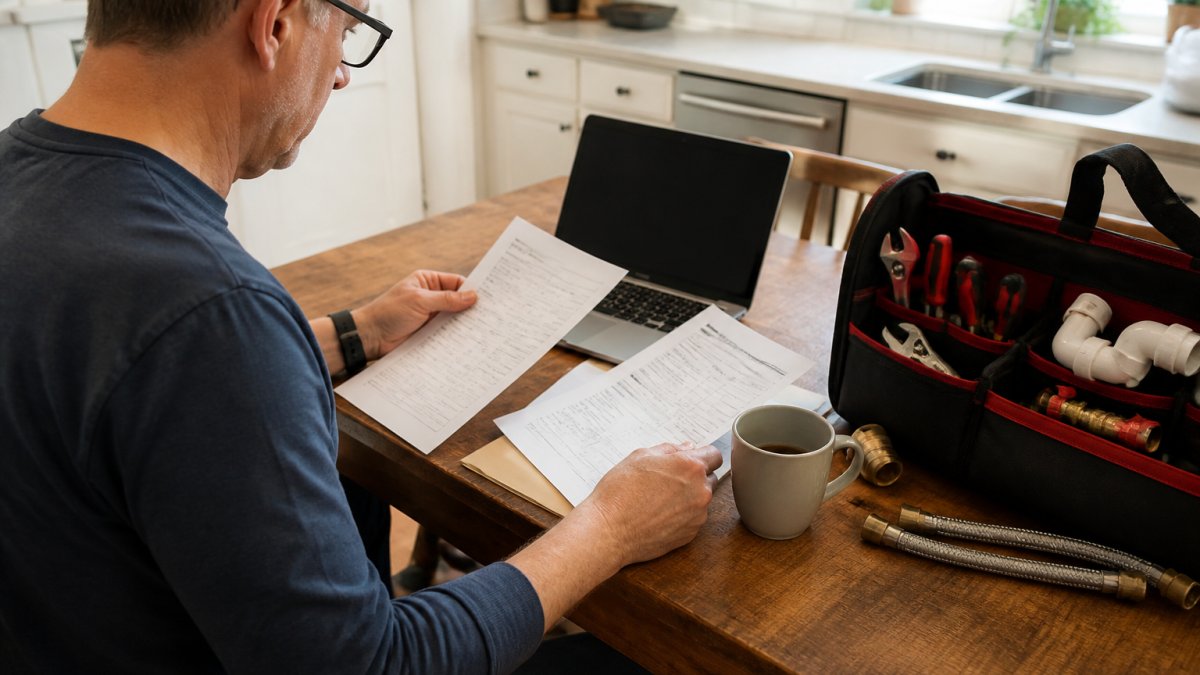
Run through this checklist before signing anything:
- Licence number provided in writing, not just verbally
- Certificate of insurance showing current liability coverage
- Coverage amount stated on the certificate, not implied
- Workers’ compensation clearance confirmed
- Business name on documents matches the quote
- Written confirmation the policy covers renovation work, not just service calls
A common mistake is accepting a photocopy with the expiry date cropped out. Ask for the full page. For a broader walkthrough of credential checks and quote comparisons, see our guide on how to find a reliable plumber.
Questions to Ask a Plumber Before Your Renovation Starts
The right questions separate a renovation specialist from a repair technician. Ask them before the first quote lands, not after demolition day.
Start with experience. “How many bathroom or kitchen renovations have you completed in the past two years?” A plumber who mostly unclogs drains may not have coordinated rough-in with a tile setter or cabinet installer. Ask who handles permit applications, who schedules inspections, and what happens if the inspection fails.
Then push on pricing. “Is this a fixed quote or an estimate?” and “What triggers extra charges?” are fair, direct questions that reveal how a contractor operates. Ask about timelines, cleanup, and whether the same crew returns each day.
Here’s what most homeowners never ask: “Who is my point of contact when the tile contractor and the plumber disagree about pipe placement?” Renovation plumbing is a coordination job as much as a technical one. If you want to see what a coordinated construction and maintenance service looks like, review our construction and maintenance plumbing offering.
What Plumbing Renovation Cost Really Includes
Plumbing renovation cost is driven by scope, access, and permit requirements, not by a flat rate anyone can quote over the phone. Any contractor who names a firm figure before seeing your walls is guessing. The useful question is not “what does a bathroom cost?” but “what is included, what is excluded, and what triggers a change order?”
A fair quote separates into five visible parts:
- Rough-in labor, removing old supply, drain, and vent lines and installing new ones, priced by fixture count and run length rather than by room.
- Fixture supply and installation, the plumber’s labor to set and connect sinks, toilets, tubs, and shut-offs, kept separate from the fixture price itself so you can see markup.
- Permit fees, paid to the municipality, and ideally shown as a pass-through line rather than folded into labor.
- Inspection costs, any reinspection fee if work fails the first time, and who pays it.
- Contingency, an explicit allowance for what is behind the drywall, stated as a percentage or a capped amount.
Older homes are where quotes diverge. A common pattern is galvanized steel supply lines that have narrowed to a pencil’s width, lead service connections, or undersized drains that cannot carry a modern fixture load. None of that is visible until demolition, and a quote with no allowance for it is not cheaper, it is just incomplete. Ask the plumber to state, in writing, what happens if the rough-in reveals a condition outside the original scope.
Fixed quote versus time and materials
Both are legitimate, but they suit different jobs. A fixed quote works when the scope is well defined, swapping a toilet, replacing a shut-off, re-piping a visible run. Time and materials suits exploratory work where the plumber cannot know the condition of the lines until the wall is open. The trap is a fixed quote on exploratory work: the contractor protects the margin by cutting scope or issuing change orders, and you end up with both a fixed number and extras.
Ask three direct questions before signing:
- Is this a fixed quote or an estimate, and what is the difference in your contract?
- What is the hourly rate and the materials markup if the job moves to time and materials?
- What triggers a change order, and who approves it in writing?
Transparent pricing means the contractor explains those triggers before the work begins, then confirms each one with you in writing. If you want to see how a coordinated construction and maintenance service handles scope and change orders, review our construction and maintenance plumbing offering.
Plumbing Permit Requirements for Renovations in Ontario
Most renovations that move, add, or replace plumbing fixtures require a permit. Ontario’s building code governs how plumbing systems are installed, and the Ontario Building Code sets the standards inspectors check against. The permit is not paperwork for its own sake, it is the record that the work was inspected while it was still visible.
What triggers a permit
A permit is typically required when you:
- Add a new fixture or relocate an existing one (a sink moved to a new wall, a toilet repositioned).
- Extend, alter, or replace supply, drain, or vent piping.
- Change the use of a space in a way that adds plumbing load, such as finishing a basement with a bathroom.
- Replace a water heater or install a backwater valve in some municipalities.
Straight fixture swaps, replacing a like-for-like toilet or faucet without moving the connection, often do not need a permit, but the rule varies by municipality. Confirm with the local building department before assuming, because the cost of being wrong is paid at resale.
How the inspection sequence works
Permits cover two distinct inspections, and the sequence matters more than the paperwork:
- Rough-in inspection, after new supply lines, drains, and venting are installed but before walls are closed. The inspector needs to see the pipe, the slope, and the venting. Drywall going up before this sign-off is the single most common renovation mistake.
- Final inspection, once fixtures are set and the system is tested. This is where the inspector confirms the installed work matches the approved plan.
A failed rough-in inspection means opening walls again, which is why the plumber should schedule the inspection as a fixed stage rather than an afterthought. Ask who books the inspection, who meets the inspector on site, and who pays any reinspection fee.
Who files, and what happens without a permit
In most cases the licensed plumbing contractor files the permit application on the homeowner’s behalf, because the application requires the contractor’s licence information. The homeowner remains responsible for the outcome. Work done without a permit can void insurance coverage if a leak or failure traces back to uninspected work, and it can surface as a problem at resale when a buyer’s inspector or lawyer asks for the permit history.
If your home predates 1960, the permit process may also surface heritage considerations, which we cover in our guide to plumbing repairs for heritage homes.
Your Plumbing Renovation Checklist: From Quote to Final Inspection
A renovation runs smoothly when the plumbing sequence is mapped before demolition. Use this checklist to keep the project on track.
| Stage | What Happens | Who Signs Off |
|---|---|---|
| Quote | Line-item scope, permit responsibility, change-order terms | Homeowner |
| Permit | Application filed with the municipality | Licensed plumber |
| Rough-in | New supply lines, drains, and venting installed | Inspector |
| Rough-in inspection | Walls stay open until approval | Municipal inspector |
| Fixture install | Sinks, toilets, tubs, and shut-offs connected | Plumber |
| Final inspection | System tested and approved | Municipal inspector |
Two stages decide the whole project: the quote and the rough-in inspection. Get the written scope right at the start, and never let drywall go up before the inspector has signed off.
Schedule Your Renovation Plumbing Consultation with Indy Plumbing
Renovations reward planning and punish shortcuts. The plumbers who protect your investment are the ones who show their licence, explain their pricing, and coordinate every stage of the rough-in.
Indy Plumbing brings more than 13 years of experience to renovation work, with licensed and insured professionals, transparent upfront pricing, and 24/7 emergency support if something fails mid-project. We handle full rough-in and fixture installation, keep the site clean, and tailor solutions for both heritage and modern properties.
Get started with Indy Plumbing and plan your renovation plumbing with a team that puts the details in writing. Reach our Orangeville plumbing team to schedule your consultation.
Frequently Asked Questions
What is a plumber’s hourly rate in Ontario?
Hourly rates for licensed plumbers in Ontario vary by region, job complexity, and whether the work is emergency or scheduled. Most plumbers charge a service call fee plus an hourly rate, and renovation work is often quoted as a project price instead. Indy Plumbing provides transparent, upfront pricing with no hidden fees, so you know the cost before work begins. Request a quote for your renovation to get an accurate figure for your project.
Do I need a permit for plumbing work during a renovation?
In Ontario, most plumbing alterations, additions, and replacements require a permit from the local municipality or conservation authority. Simple fixture swaps may not, but moving drains, installing new lines, or changing water heaters usually do. A licensed plumber can tell you exactly what your project needs and can often handle the permit application for you. Always confirm plumbing permit requirements with your local building department before work starts.
How do I find out if a plumber is licensed in Ontario?
Ask for the plumber’s licence number and verify it with the Ontario College of Trades or the municipal licensing body. A legitimate licensed plumber will provide this without hesitation, along with proof of insurance. Indy Plumbing’s team is licensed and insured, and we are happy to share our credentials. You can also ask for references from recent renovation projects in Orangeville to confirm workmanship.
What should a plumbing renovation quote include?
A complete plumbing renovation quote should list the scope of work, materials and fixtures (with brands or grades), labour, permit fees, disposal costs, and any contingency for unexpected issues like old pipes. It should also state the payment schedule and warranty terms. Indy Plumbing offers transparent, upfront pricing with no surprise charges, so your quote covers everything discussed before work begins. Compare quotes line by line to spot missing items.

Comments are closed