

Last Updated: October 23, 2026
Quick Summary
A tank vs. tankless water heater decision for small homes hinges on space and budget: tank systems cost less upfront and need minimal installation, while tankless units save space, last 15-20 years, and reduce energy waste but require higher upfront investment and potential upgrades to gas, venting, or electrical systems.
- Tank systems occupy 150-230 litres of floor or closet space; tankless units mount on walls and are roughly medicine-cabinet sized.
- Tankless units last 15-20 years versus 10-15 years for tanks, reducing replacement cycles over decades.
- Tankless installation often requires gas-line upsizing, new venting, or electrical service upgrades that can cost more than the unit itself.
- Peak demand sizing is critical: add your realistic simultaneous fixture flow rates and match to winter incoming water temperature, not summer figures.
- Tankless systems need annual flushing to remove mineral buildup and maintain heat exchanger efficiency, especially in hard-water areas.
Table of Contents
- How Tank and Tankless Water Heaters Work
- Tank Water Heater Advantages and Disadvantages
- Tankless Water Heater Advantages and Disadvantages
- Energy Efficiency and Operating Costs
- Sizing a Water Heater for Small Homes
- Tankless Water Heater Installation Cost and Requirements
- Tankless Water Heater Maintenance Tips and Lifespan
- Which System Is Right for Your Small Home
- Frequently Asked Questions
How Tank and Tankless Water Heaters Work
A tank water heater stores heated water in an insulated container, ready for use. A tankless water heater heats water on demand as it flows through the unit, with no storage tank.
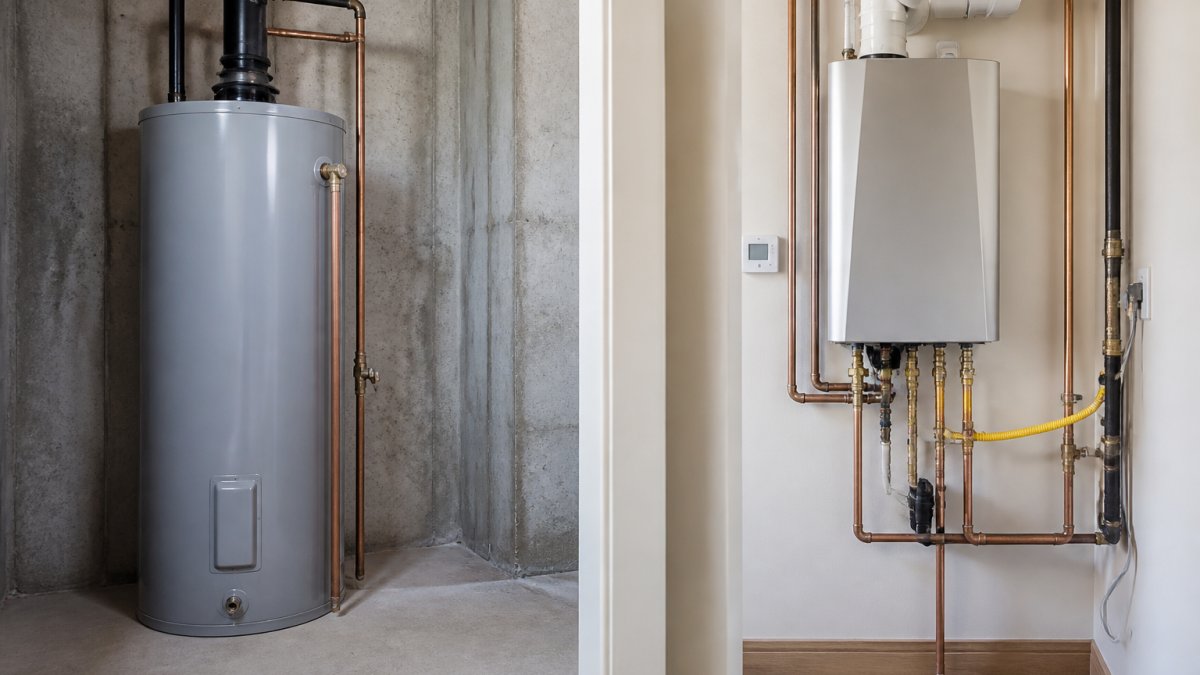
Tank systems use a gas or electric heating element to warm water in a 150-230 litre storage tank. Tankless units pass cold water through a heat exchanger, emerging hot within seconds, no waiting for a tank to refill (How It Works, Whole-Home Gas Tankless Water Heaters).
For small homes, this difference matters. Tank systems occupy floor or wall space and need a dedicated area. Tankless units mount on a wall and take up minimal space, a key advantage when square footage is limited.
Tank Water Heater Advantages and Disadvantages
Tank water heaters remain popular because they’re straightforward and affordable upfront.
The disadvantages are significant for small homes. Tanks waste energy through standby heat loss, continuously reheating water that cools in the tank.
A common mistake is underestimating how much space a tank requires. A 190-litre tank isn’t just 190 litres of physical size; it’s a bulky cylinder that needs clearance for maintenance and repairs.
Tankless Water Heater Advantages and Disadvantages
Tankless systems excel in small homes because they’re compact and energy-efficient. Advantages include space savings (units are roughly medicine-cabinet sized), no standby heat loss, and continuous hot water.
The disadvantages require honest consideration. Tankless units cost significantly more upfront. Installation is more complex and often requires upgrades to gas lines, venting, or electrical capacity, especially in older homes.
What most guides miss: tankless performance depends heavily on incoming water temperature.
Energy Efficiency and Operating Costs
Tankless systems use less energy because they don’t maintain a heated tank 24/7.
Operating costs also reflect fuel type. Gas tankless units are more efficient than electric tanks but require proper venting. According to Natural Resources Canada, tankless systems can reduce energy consumption by 10-20% compared to traditional tank models (Energy Efficiency of Water Heaters, Natural Resources Canada, 2024).
Many homeowners assume tankless automatically saves money. The reality is more nuanced: savings depend on your current system, local energy rates, hot water usage, and installation costs. A professional assessment reveals whether the payback timeline makes financial sense.
Sizing a Water Heater for Small Homes
Proper sizing is where most small-home decisions go wrong, and it is the step general tank-versus-tankless guides skip. Sizing is not about picking the biggest unit; it is about matching the unit to your peak simultaneous demand and incoming water temperature. Get either wrong, and you end up with cold showers or a unit that cycles on and off.
Step 1: Build a peak-demand worksheet
List every hot-water fixture and the flow rate it draws when running. Use the fixture’s rated flow, not a guess. Typical figures:
- Standard showerhead: about 9.5 litres per minute (lpm)
- Low-flow showerhead: about 5.7-7.6 lpm
- Kitchen faucet: about 5.7 lpm
Now identify the realistic worst case, when the most fixtures run at once. In a small home, this is usually a morning pattern: one shower plus the kitchen faucet plus a washing machine. Add those flow rates; that total is your peak demand in lpm.
Size to the realistic peak, not the theoretical maximum. A household of two rarely runs a shower, the dishwasher, and the laundry simultaneously. Sizing to every fixture at once overspends on capacity you will never use.
Step 2: Adjust for incoming water temperature
This is the step most guides omit, and it matters most in cold climates. A tankless unit’s flow rate is rated for a specific temperature rise, the difference between incoming groundwater and target output temperature.
A unit rated at 19 lpm at a 22°C rise delivers noticeably less flow at a 39°C or 44°C rise. Check the manufacturer’s flow-rate chart at your actual temperature rise, not the headline number on the box. Size to the headline gpm, and a cold snap will expose the shortfall.
In cold-climate small homes, always size tankless to the winter incoming-water temperature, not the summer figure. A unit that performs well in July can underdeliver in January.
Step 3: Match the result to the technology
For a tank system, peak demand translates into storage volume. A 115-150 litre tank typically serves two to three people in a small home, provided the recovery rate keeps up with back-to-back use.
For a tankless system, peak demand translates directly into flow rate. Choose a unit whose rated flow at your winter temperature rise meets or exceeds your worksheet total.
Step 4: Account for small-home demand concentration
Small homes concentrate demand because fixtures sit close together and run at the same time.
Sizing is where professional assessment pays for itself. Guessing wrong leaves you with cold showers, and correcting an undersized unit costs more than sizing it right the first time.
Tankless Water Heater Installation Cost and Requirements
Tankless water heater installation cost varies widely because the unit itself is only part of the job. The real cost driver is what your home’s existing gas, electrical, and venting infrastructure can support. Most small homes need at least one upgrade; knowing which one applies is the difference between a straightforward swap and a multi-trade project.
Gas models: venting and gas-line sizing
A gas tankless unit needs two things a tank often does not: a properly sized gas line and dedicated venting.
- Gas-line sizing. Tankless units fire at a higher input rate than many tank units, so the existing gas line may be undersized. A contractor checks the line diameter and run length against the unit’s input rating. Upsizing a gas line can mean running new pipe from the meter, which adds cost and disruption.
- Venting. Tankless units vent differently from tanks. Many use direct-vent or concentric venting through a side wall rather than a chimney. That can be an advantage in a small home with no chimney, but it requires a suitable exterior wall location and clearance from windows, doors, and property lines. Condensing units also need a drain for condensate.
Improper venting is a carbon monoxide hazard (Carbon monoxide: Overview). Venting must follow the manufacturer’s instructions and local code, and it is not a DIY task.
Electric models: circuit capacity and service upgrades
Electric tankless units draw a large current, often requiring dedicated circuits that a small home’s existing panel may not have. A contractor checks the panel’s available capacity and the service size. If the panel is full or the service is undersized, an electrical upgrade, sometimes a service upgrade, is needed before the unit can be installed. That upgrade can cost more than the unit itself, which is why electric tankless is rarely the budget option it appears to be.
Placement in small-home layouts
Tankless units are compact, but placement still matters:
- Utility rooms and closets need clearance for access and, for gas units, combustion air and venting.
- Wall mounting requires a structurally suitable wall and space for the vent and water connections.
- Point-of-use units can serve a distant fixture, but each unit needs its own power or gas supply.
What the installation timeline looks like
A straightforward replacement where gas, venting, and electrical already meet requirements can take a day or two. Homes needing a gas-line upsizing, new venting, or an electrical upgrade take longer and involve more than one trade. Professional installation is essential: improper venting or electrical work creates safety hazards, and DIY work risks carbon monoxide exposure, electrical fires, or a voided warranty.
Before comparing unit prices, get an installation assessment. The upgrade cost—gas line, venting, or electrical service—is often the deciding factor in whether tankless makes financial sense for a small home.
A licensed installer can tell you which upgrades your home needs and what they will cost, so you can compare the true installed cost of tankless against a tank replacement rather than the sticker price alone.
Tankless Water Heater Maintenance Tips and Lifespan
Check intake filters regularly and replace as needed. Inspect venting annually to keep it clear and unobstructed. In mineral-heavy water regions, annual professional flushing extends unit life significantly. According to Energy Star, annual maintenance can extend the life of a tankless unit by several years (Energy Star Water Heaters).
Tankless units typically last 15-20 years with proper maintenance, versus 10-15 for tanks. This assumes consistent upkeep; a neglected unit may fail earlier. The longer lifespan means fewer replacement cycles over decades, partially offsetting the higher upfront cost.
Which System Is Right for Your Small Home
The choice between tank and tankless depends on your priorities, budget, and home’s physical constraints. Choose a tank vs. tankless water heater based on these factors:
Tank systems make sense if: you have a limited upfront budget, your home has existing utility connections requiring no upgrades, space is adequate, and you’re comfortable replacing the unit every 10-15 years. They’re reliable, simple, and require minimal installation complexity.
Tankless systems make sense if: space is severely limited, you want long-term energy efficiency, your home can accommodate necessary upgrades, and simultaneous demand is moderate.
| Factor | Tank System | Tankless System |
|---|---|---|
| Space required | 115-230 litres, floor/closet space | Wall-mounted, compact |
| Upfront cost | Lower | Higher |
| Installation complexity | Simple | Moderate to complex |
| Energy efficiency | Lower (standby loss) | Higher (on-demand) |
| Lifespan | 10-15 years | 15-20 years |
| Simultaneous demand | Good capacity | Limited by flow rate |
| Maintenance | Minimal | Annual flushing needed |
At Indy Plumbing, we assess each home individually. We provide transparent guidance on installation costs, maintenance requirements, and realistic payback timelines so you make an informed decision.
Schedule a consultation with our licensed team to evaluate your specific situation.
Choosing between a tank and tankless water heater requires balancing upfront cost, space constraints, and long-term efficiency. We provide transparent, upfront pricing and handle everything from proper sizing to professional installation with minimal disruption to your home. Schedule Service today and let us help you select the right water heating solution for your small home.
Frequently Asked Questions
Which is better for a small home, a tank or tankless water heater?
Neither is universally better; it depends on your household’s simultaneous hot-water demand and budget. Tank water heaters suit homes where multiple people shower or use hot water at once; tankless systems work well for low-demand households or where space is extremely limited. Small homes with 1-2 residents and staggered usage often benefit from tankless, while families with simultaneous demand may find a smaller tank more practical. Consider your daily usage patterns and available space before deciding.
Do tankless water heaters provide enough hot water for small homes?
Tankless systems deliver continuous hot water, but their flow rate (measured in litres per minute) determines capacity. A properly sized tankless unit for a small home typically handles one or two simultaneous hot-water uses—a shower and a sink, for example. If your household rarely needs hot water from multiple fixtures at once, a tankless system provides adequate supply. If multiple people shower simultaneously, you may experience reduced temperature or flow, making a small tank heater a better fit.
How much does tankless water heater installation cost?
Installation costs vary based on your home’s existing plumbing, gas or electrical capacity, and venting requirements. Upgrading gas lines, electrical service, or installing new venting can significantly increase the total expense. For a transparent quote tailored to your small home’s specific needs, contact Indy Plumbing for a free assessment. Our licensed professionals will outline all costs upfront so you understand the full investment before work begins.
How long do tankless water heaters last compared to traditional tanks?
Tankless water heaters typically last 15-20 years with proper maintenance, while traditional tank models last 8-12 years. Tankless longevity depends on water quality and regular descaling to prevent mineral buildup. Tank heaters corrode from the inside over time and eventually fail. For small homes, the longer lifespan of a tankless system can offset its higher upfront cost over the equipment’s lifetime, though installation and maintenance requirements differ.

Comments are closed