

Table of Contents
- Why Transparent Pricing Matters in Residential Plumbing
- Plumbing Service Price Factors That Affect Your Estimate
- Flat Rate vs Hourly Plumbing Pricing: Which Model Protects You
- Understanding Your Plumbing Invoice: Costs Broken Down
- Questions to Ask a Plumber Before Hiring
- Hidden Charges and How to Avoid Them
- How to Verify and Compare Plumbing Estimates
- Conclusion
- Frequently Asked Questions
Last Updated: September 28, 2026
Why Transparent Pricing Matters in Residential Plumbing
When a pipe bursts at 2 AM, you’re thinking about water damage and ruined flooring, not cost comparison. That’s when plumbing companies know they can charge whatever they want, and many do.
Transparent pricing for residential plumbing repairs changes that dynamic. It means you know what you’re paying for before work starts, not after the invoice arrives with surprise charges. Homeowners often face unauthorized diagnostic fees, material markups that triple actual costs, and after-hours surcharges buried in fine print, turning a $400 repair into $800.
Hidden charges cost more than money: they create stress, invoice disputes, and confusion about fair pricing. Transparent pricing eliminates this. You know exactly what labor, materials, and the total will be before work starts.
Plumbing pricing varies wildly, a faucet replacement might cost $150 or $400 depending on fee structure, not quality. Understanding these structures protects you.
Ask for an itemized written estimate before work begins. If a plumber refuses or says “it depends on what we find,” that’s a red flag. Legitimate professionals can give you a range or a detailed estimate based on what they see during the initial inspection.
Plumbing Service Price Factors That Affect Your Estimate
Plumbing estimates depend on several factors beyond hourly labor rates. Understanding them helps you recognize fair pricing and spot inflated quotes.
Complexity of the repair varies widely. A faucet replacement takes two hours; a water heater installation with limited access, new gas lines, and permits takes a full day. Charges of $200 and $2,500 respectively are both reasonable.
Materials and parts are a major cost driver. A standard faucet costs $40 retail; a commercial-grade one costs $200. Plumber markups typically run 20-50%. Ask for the specific brand and model so you can research actual costs and verify the markup.
Service call fees ($75 or more) cover diagnostic time, vehicle costs, and overhead. Some plumbers roll this into the final invoice; others waive it if you hire them. It should be disclosed upfront.
Geographic location and service area affect pricing. Rural plumbers may charge less hourly but more for travel; urban plumbers have higher overhead but faster response times.
Emergency or after-hours work carries a 50-100% surcharge for nights, weekends, and holidays. This is standard and justified.
Before comparing quotes, ensure each estimate covers the same scope: same materials, same timeline, same service area. Comparing a basic faucet to a premium fixture or a daytime appointment to a midnight emergency will give you false price differences.
Flat Rate vs Hourly Plumbing Pricing: Which Model Protects You
The pricing model a plumber uses shapes how transparent their costs actually are. Understanding the difference between flat-rate and hourly pricing helps you choose the model that works best for your situation.
Hourly labor rates charge for time worked plus materials. In theory, you only pay for actual work needed and save money if the job finishes early.
The problem: you don’t know how long a job should take. Hourly plumbers have no incentive to finish quickly, the longer the job, the more they earn. This can lead to unnecessary work suggestions or inefficiency.
Hourly pricing also makes budgeting difficult. You get a range but not a final cost until work is done.
Flat-rate pricing quotes a single price for the entire job. You know the total before work starts, protecting you from surprise charges.
Flat rates work best for standard repairs with clear scope. For complex jobs like tree-root clogs requiring excavation, clarify what’s included and what costs extra.
Flat-rate pricing incentivizes efficiency, the plumber profits by finishing quickly, so they show up on time and work steadily.
For complex jobs, a hybrid model works best: a diagnostic fee to inspect, then a flat rate for the repair once scope is agreed.
If a plumber quotes hourly rates without a firm upper limit, ask for one. “3-5 hours, probably around $600-800” is vague. Push for “we’ll stop at $800 unless you authorize more work in writing.” A professional can commit to this; one who resists is hiding something.
Understanding Your Plumbing Invoice: Costs Broken Down
A detailed invoice should list labor, materials, and fees separately. Vague invoices (“plumbing work: $800”) prevent you from verifying fair charges.
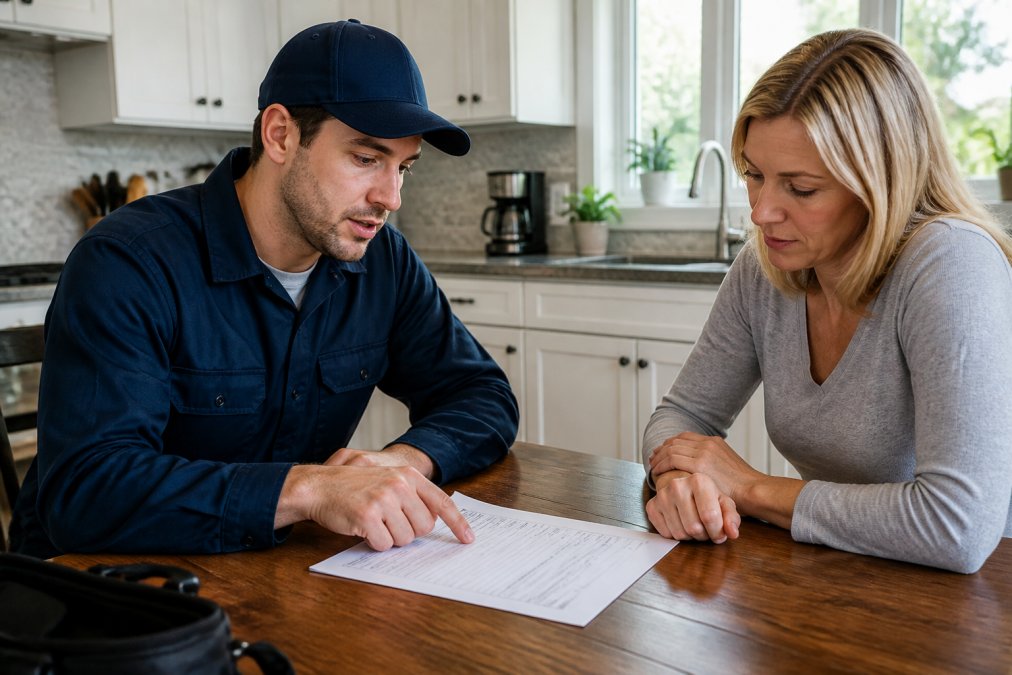
Labor costs should specify hourly rate and hours worked, or the service and agreed flat rate. “Labor: $600” with no breakdown requires clarification.
Material costs should list each part separately with brand, model, and quantity. “Faucet: $120” is clear; “Materials: $300” is not. You can Google part numbers to verify wholesale costs.
Service fees should be itemized separately: service call, diagnostic, permit, disposal. Knowing what you’re paying for helps you identify padding.
A complete invoice includes the date, scope of work, and warranty information. Missing details signal lack of transparency.
Red flag: invoices that increase significantly without written approval. Small variances (5-10%) are normal; doubling the quote is not. Legitimate plumbers get approval before exceeding estimates.
Questions to Ask a Plumber Before Hiring
The questions you ask before hiring reveal how transparent a plumber will be. Use these to separate professional, upfront companies from those that hide their pricing.
“Can you provide a written estimate before starting work?” This is non-negotiable. If they refuse or say “it depends,” move on.
“What’s included in your service call fee, and will you waive it if I hire you?” Either approach is fine; you just need to know upfront.
“How do you charge for materials, at cost, or with a markup?” A 30% markup is standard; 100%+ is excessive. Knowing this helps you evaluate the invoice.
“What happens if the job takes longer than expected?” A professional will get approval before exceeding the estimate. One who says “we’ll figure it out later” is a risk.
“Are you licensed and insured?” Ask to see proof. A licensed plumber has passed exams and meets safety standards. Insurance means you’re protected if something goes wrong. If they can’t show you both, don’t hire them.
“What’s your warranty on the work?” Reputable plumbers stand behind their work with a warranty (typically 1-2 years on labor, longer on parts). If they offer no warranty, that’s a warning sign.
“Can you explain what you found and why this repair is necessary?” A good plumber explains clearly in plain language. Jargon or pressure for unnecessary work is a red flag.
Hidden Charges and How to Avoid Them
Hidden charges are the main reason homeowners distrust plumbing companies. Knowing where these charges hide helps you spot them in advance.
Diagnostic or troubleshooting fees ($100-200) are legitimate but should be disclosed upfront. A transparent company applies it to the final invoice if you hire them.
Permit and inspection fees are real costs, not padding. If your repair requires a municipal permit (many do), someone has to apply for it, pay the fee, and schedule the inspection. That costs money. But the plumber should tell you upfront, “This job requires a permit; that’s $150.” Not, “We’ll handle it” and then surprise you with the charge later.
Trip charges or travel fees appear on invoices when the plumber travels far from their main service area.
A transparent estimate includes: scope of work, materials with brand/model, labor hours or flat rate, all fees itemized separately, timeline, and warranty. If any of these are missing, ask for clarification before work starts.
How to Verify and Compare Plumbing Estimates
Getting multiple estimates is the best way to protect yourself from overpricing. But comparing them requires understanding what you’re actually comparing.
Conclusion
Transparent pricing for residential plumbing repairs isn’t a luxury, it’s a necessity. Homeowners who demand clarity upfront avoid surprise charges, make better decisions, and build trust with their plumber.
| Pricing Model | Best For | Key Advantage |
|---|---|---|
| Flat Rate | Standard repairs with clear scope | Budget certainty before work starts |
| Hourly | Complex jobs with unknown variables | Pay only for actual time spent |
| Hybrid (Diagnostic + Flat Rate) | Major repairs requiring inspection first | Clarity after assessment, no surprises |
Frequently Asked Questions
What should a transparent pricing estimate for residential plumbing include?
A transparent pricing estimate must itemize labor costs, material costs, service call fees, and any applicable taxes or permit charges. It should list the hourly labor rate or flat-rate price, the quantity and cost of parts and materials, diagnostic or troubleshooting fees if applicable, and any after-hours surcharges. A written estimate protects both you and the plumber by establishing a fixed-price agreement upfront. Reputable professionals provide this breakdown before work begins, allowing you to understand exactly what you’re paying for.
What questions should I ask a plumber before hiring to ensure transparent pricing?
Ask whether they charge hourly or flat-rate, what their minimum service charge is, whether the estimate includes all parts and labor, what warranty or guarantee they provide on their work, if there are any additional fees for emergency or after-hours calls, and how they handle unexpected issues discovered during the job. Request a written estimate before work starts. Ask about their licensing and insurance status. Clarify whether the quoted price is binding or if it may change, and under what circumstances. These questions help you avoid surprises and ensure you’re working with a licensed professional committed to cost transparency.
How do flat-rate vs hourly plumbing pricing models protect homeowners differently?
Flat-rate pricing provides upfront cost certainty; you know the total before work begins, making budgeting easier and protecting you from inflated labor charges if a job takes longer than expected. Hourly pricing is transparent about the rate but introduces uncertainty about total cost. For complex installations or heritage property work, flat-rate agreements often work better. For diagnostic calls or minor repairs where scope is unclear, hourly rates may be fairer. Request a written estimate under either model to avoid hidden charges. A licensed professional should clearly explain which model applies and why, so you can make an informed choice.
What are common hidden costs in plumbing quotes that I should watch for?
Watch for service call fees not mentioned upfront, material markups that aren’t itemized separately, permit fees for certain installations, after-hours or emergency surcharges, diagnostic or troubleshooting fees that weren’t disclosed, and unexpected costs for complications discovered during work. Some invoices bundle labor and materials without showing the breakdown, making it hard to verify fairness. Request an itemized quote that separates parts and materials from labor cost. Ask whether the estimate is a fixed-price agreement or subject to change. Transparency means the plumber explains every charge in advance, not surprising you once work is underway.
Comments are closed