

Table of Contents
- Understanding Well Water Quality and Contaminants
- Well Water Testing Requirements Before Filtration
- Types of Filtration Systems for Well Water
- Iron and Manganese Removal from Well Water
- Whole Home Water Filtration System Cost and Installation
- Point-of-Use vs. Whole House Filtration: Which Approach Works Best
- Maintenance and System Longevity
- Frequently Asked Questions
Last Updated: September 19, 2026
Understanding Well Water Quality and Contaminants
Well water quality depends on your aquifer’s chemistry, making water filtration for wells essential for safe drinking water. Unlike municipal systems, well owners must understand their own water chemistry and contaminant profile before selecting filters.
Common well water contaminants include sediment, dissolved minerals (iron, manganese, calcium), coliform bacteria, volatile organic compounds, hydrogen sulfide gas, and total dissolved solids.
Each well draws from a specific groundwater source with unique chemistry; a neighbor’s well may have entirely different contaminants. This variability is why testing must precede filtration.
The biggest mistake well owners make is assuming their water is safe because it “looks clear.” Coliform bacteria, volatile organic compounds, and dissolved minerals are invisible. Clarity tells you nothing about potability.
Well Water Testing Requirements Before Filtration
Test your well water before selecting filtration equipment. A water analysis report prevents buying filters that won’t address your actual problems.
Start with a bacterial test for coliform bacteria, the screening test for pathogenic bacteria. If positive, you have a serious issue requiring immediate attention. Many well owners test annually as a safety baseline.
Beyond bacteria, a comprehensive analysis should cover:
- Total dissolved solids, the mineral load in your water
- Iron and manganese levels, cause staining and taste issues
- Hardness, measured in parts per million, determines if you need softening
- pH level, affects corrosion and filter performance
- Hydrogen sulfide, creates odor problems
- Nitrates and nitrites, indicate contamination from agricultural or septic sources
Testing labs offer packages covering standard parameters at modest cost compared to buying the wrong water filtration system. A water analysis report provides baseline data to choose equipment addressing your specific issues.
Professional testing provides documentation for future reference and is important if you sell; buyers want proof of water quality and treatment.
Test your water before you filter it. The analysis report becomes your roadmap for selecting the right system and proves your water quality to future buyers.
Types of Filtration Systems for Well Water
Water filtration for wells comes in distinct categories addressing different contaminants. Understanding these systems helps you build a strategy matching your water chemistry.
Sediment and Particulate Filtration
Sediment filters are the foundation of most well water systems, removing visible particles, rust, and debris that damage downstream equipment. A 20-micron filter catches larger particles; 5-micron ratings remove finer sediment.
Lower micron ratings capture smaller particles but reduce flow rate and require more frequent backwashing. Most systems use a 20-micron pre-filter followed by finer stages to prevent clogging and extend system life.
Sediment filters work through mechanical straining and don’t remove dissolved contaminants, bacteria, or chemicals. They protect downstream filters from clogging.
Reverse Osmosis Systems
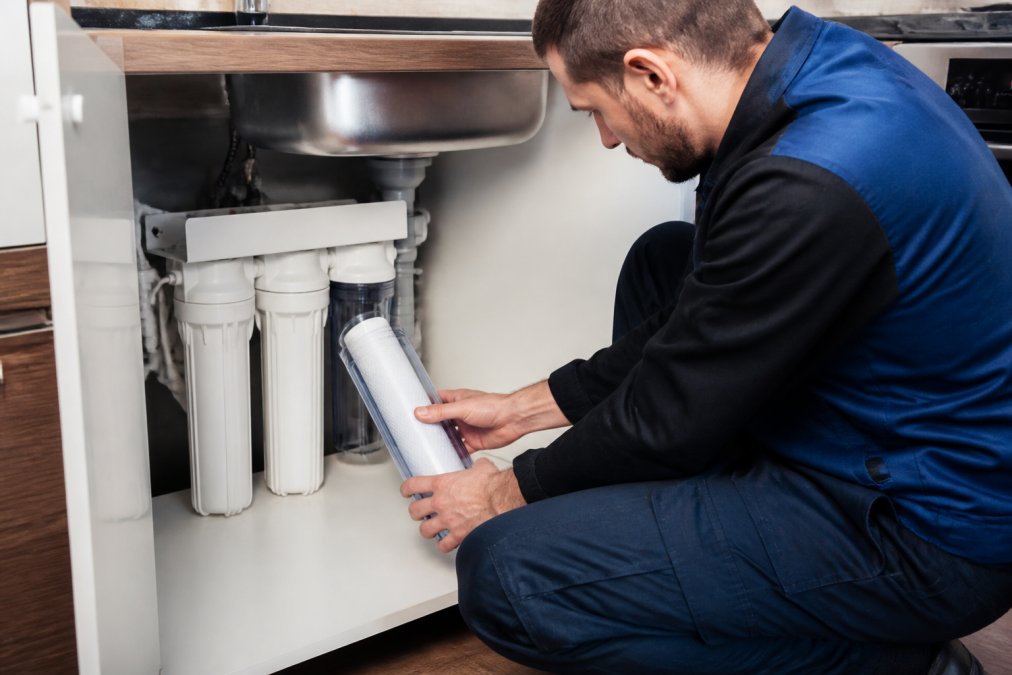
Reverse osmosis (RO) forces water through a semipermeable membrane at high pressure, leaving contaminants behind. It effectively reduces total dissolved solids, minerals, and chemical contaminants.
RO systems reduce contaminants by 75-99 percent and produce two streams: pure water and concentrated waste water (brine). They use 3-4 liters of waste water for every 1 liter of purified water.
Point-of-use RO systems work at a single tap, usually the kitchen sink. Most homeowners use RO for drinking and cooking water only, combined with other filtration for the rest of the house.
Ion Exchange and Water Softening
Ion exchange removes hardness minerals (calcium and magnesium) by swapping them for sodium or potassium ions. This process is called water softening. Hard water causes scale buildup in pipes, reduces soap effectiveness, and leaves spots on dishes and fixtures.
An ion exchange system contains resin beads that attract hardness minerals and release sodium in exchange. When saturated, regeneration with brine flushes out trapped minerals and recharges the resin.
Water softening improves downstream filter performance and extends plumbing life, but increases sodium content. Potassium-based systems are available as a lower-sodium alternative at higher cost.
Iron and Manganese Removal from Well Water
Iron and manganese are common well water contaminants causing rust staining, metallic tastes, and pipe clogging. Effective removal requires understanding your water’s pH and dissolved oxygen levels.
How Water Chemistry Affects Iron and Manganese Removal
Dissolved iron oxidizes into solid particles when exposed to oxygen or chemical oxidants. Oxidation rate depends heavily on pH: below 6.5, iron oxidizes slowly; at 7.0-8.0, oxidation happens readily. Acidic water may require pH adjustment before oxidation filters work effectively.
Manganese oxidizes more slowly than iron and requires stronger oxidants (potassium permanganate or ozone) or specialized manganese-removal media. If your water shows manganese above 0.05 mg/L, confirm with your testing lab whether simple oxidation will work.
High calcium and magnesium levels can interfere with oxidation and cause scale buildup.
Oxidation Methods and Their Trade-Offs
Air injection systems introduce oxygen to allow iron to oxidize naturally. They’re low-cost and chemical-free but work only if your pH is neutral or slightly alkaline and manganese is low. Low-yield wells may experience pressure drop issues.
Sizing Iron Removal to Your Well’s Flow Rate
Many homeowners buy oxidation systems sized for municipal flow rates without checking actual well yield. If your well produces 3 liters per minute and you install a system rated for 8 liters per minute, oxidation won’t complete and staining continues.
If your water is acidic (pH below 6.5) or contains manganese above 0.05 mg/L, air injection alone will not solve your problem. Confirm your water chemistry before purchasing an oxidation system, or you’ll buy equipment that cannot address your actual contaminant profile.
Iron and manganese removal success depends on matching the oxidation method to your water’s pH, manganese level, and well flow rate. A water analysis report should include pH and dissolved oxygen measurements, not just iron and manganese concentrations. Use these numbers to select the right removal strategy, not just the cheapest option.
Whole Home Water Filtration System Cost and Installation
A whole-house filtration system treats water at the point of entry, protecting all fixtures and appliances from sediment, corrosion, and scale buildup. Installation involves connecting the system to your main water line downstream of your pressure tank (if you have one) and ensuring the system is sized correctly for your household’s peak water demand.
System Sizing and the Low-Yield Well Challenge
Whole-house systems must be sized to your household’s peak flow rate. A typical household uses 8-12 liters per minute at peak; most commercial filters are rated for 10-15 liters per minute.
Installation and Pressure Drop
Whole-house systems create pressure drop as water passes through cartridges. A well-designed system should cause no more than 10-15 psi of pressure drop. If your home pressure is already low (below 40 psi), filtration can drop you below minimum needed for proper function.
Ongoing Maintenance and Costs
Sediment pre-filters typically need replacement every 6-12 months, or every 3-4 months if your water has high sediment load. Each replacement costs $30-$80 per cartridge.
If your well yield is below 5 liters per minute, do not install a standard whole-house filtration system without consulting a well contractor. Oversizing the system will cause chronic low pressure and may damage your well pump and pressure tank. A hybrid approach (whole-house sediment filter + point-of-use premium filtration) is often the better solution for low-yield wells.
Whole-house filtration protects your entire plumbing system, but sizing and installation must account for your well’s actual flow rate and recovery time. Low-yield wells require special consideration, either a pressure tank upgrade, a reduced-flow system, or a hybrid approach. Professional installation ensures your system works with your well, not against it.
Point-of-Use vs. Whole House Filtration: Which Approach Works Best
Point-of-use systems treat water at a specific tap and are lower-cost for drinking and cooking water. Whole-house systems protect your entire plumbing system from sediment and corrosion. Choose based on your water quality: minor issues may need only point-of-use filtration; high sediment, iron, or hardness require whole-house filtration. Many homeowners use both.
| Approach | Best For | Cost Range | Maintenance |
|---|---|---|---|
| Point-of-Use | Drinking/cooking water only | Lower initial investment | Filter replacement every 6 months |
| Whole House | All fixtures and appliances | Higher initial investment | Cartridge replacement every 6-12 months |
| Combined | Complete coverage with premium drinking water | Moderate-to-high investment | Both systems require maintenance |
Maintenance and System Longevity
Water filtration systems require regular maintenance to perform effectively. Sediment filters need cartridge replacement every 6-12 months depending on water quality. If your water has high sediment load, you may replace cartridges more frequently.
Frequently Asked Questions
How do I know if my well water needs a filtration system?
Start with a water analysis report from a certified lab. Test for total dissolved solids, coliform bacteria, iron, manganese, hydrogen sulfide, and volatile organic compounds. If your water shows discoloration, odor, or taste issues, filtration is likely needed. Well water testing requirements vary by region, but annual testing is standard practice. Contact your local health authority for specific testing guidelines and approved laboratories.
What is the best type of water filtration system for well water?
The best system depends on your water analysis results. Multi-stage filtration combining sediment filters, ion exchange for hardness, and reverse osmosis for dissolved contaminants works well for most wells. If iron and manganese removal is your priority, oxidation filters or specialized ion exchange resins are effective. Reverse osmosis membranes remove up to 99% of dissolved solids but reduce flow rate. Have a professional assess your groundwater quality to recommend the right combination.
What is the most effective way to purify well water for residential use?
A whole home water filtration system combining multiple stages addresses most well water issues. Start with sediment filtration to remove particulate matter and turbidity, then use ion exchange for water hardness and manganese removal. Add activated carbon for volatile organic compounds and odor. For highest purity, install reverse osmosis at the point-of-use for drinking water. Ultraviolet sterilization or chlorination adds bacterial protection. Professional installation ensures proper system integration and maintains water pressure throughout your plumbing infrastructure.
How often should well water filtration systems be serviced?
Filter cartridges typically need replacement every 6 to 12 months, depending on water quality and flow rate. Sediment filters clog faster in high-turbidity water. Reverse osmosis membranes last 2 to 3 years. Backwashing systems (common in whole house setups) should run weekly to prevent filter saturation. Schedule annual professional maintenance to check for pressure drop, system efficiency, and potential contaminant breakthrough. Your water analysis report will guide replacement intervals based on your specific aquifer and groundwater profile.
Comments are closed