

Table of Contents
- Why Older Water Heaters Fail
- Understanding Sediment Buildup in Hot Water Tanks
- How to Test Your Water Heater Pressure Relief Valve
- Anode Rod Replacement Frequency and Process
- Step-by-Step Annual Maintenance to Prevent Failure
- Smart Leak Detection and Water Damage Protection
- Insurance Implications of Aging Water Heaters
- Common Mistakes That Speed Up Failure
- Frequently Asked Questions
Last Updated: September 25, 2026
Why Older Water Heaters Fail
Older water heaters face corrosion, sediment buildup, and metal weakening that combine to cause failure, making water heater failure prevention essential.
Most water heaters last 8-12 years with proper care. Older units fail faster due to skipped maintenance and anode rod depletion, after which rust spreads rapidly.
Ignored warning signs often lead to sudden leaks and expensive emergencies that basic maintenance could have prevented.
Preventing water heater failure in older homes is straightforward and requires only a plan and a few hours per year.
Understanding Sediment Buildup in Hot Water Tanks
Sediment buildup occurs when minerals from hard water separate and sink to the tank bottom.
Over years, sediment insulates the heating element, forcing the system to work harder and use more energy while trapping moisture that accelerates corrosion.
You’ll notice signs:
- Popping or rumbling sounds from the tank
- Discolored water from the hot tap
- Reduced hot water output
- Higher energy bills
Flushing your tank once yearly removes sediment before it causes damage. This single step extends your water heater’s life significantly. It also improves efficiency and reduces strain on the heating system.
Sediment hardens over time, making flushing more difficult and risky; prevention is always easier than repair.
How to Test Your Water Heater Pressure Relief Valve
The pressure relief valve (T&P valve) is a safety device that opens if pressure or temperature gets too high; without it, your tank could rupture.
Here’s how to test it:
- Turn off power to the water heater (gas or electric)
- Place a bucket underneath the valve’s discharge pipe
- Lift the test lever on the valve briefly; you should hear a hiss and see water flow
- Release the lever; water should stop immediately
- Wait 30 seconds; no water should drip from the pipe
If water doesn’t flow or continues dripping after release, the valve is faulty and needs replacement. A non-functional valve is a serious safety risk.
Test annually; catching a failed valve early prevents tank rupture and water damage.
A stuck or leaking pressure relief valve can cause tank rupture, flooding, or scalding injuries. If your valve fails the test, contact a licensed plumber immediately. Do not delay.
Anode Rod Replacement Frequency and Process
The sacrificial anode rod is a magnesium or aluminum rod designed to corrode instead of the tank walls. Without it, rust spreads rapidly, leading to pinhole leaks and catastrophic failure.
How Anode Rods Prevent Tank Corrosion
Tank corrosion occurs through galvanic action when dissimilar metals interact in water. The anode rod is more reactive than tank steel, so it corrodes while the tank remains protected.
Once depleted, galvanic protection stops and the tank itself corrodes. Most failures occur within 1-2 years of anode rod depletion.
Anode Rod Lifespan Variables
Anode rods typically last 3-5 years but vary based on water hardness, temperature, usage, rod material, and water chemistry. Hard water and higher temperatures accelerate depletion.
Inspecting and Replacing the Anode Rod
Check your anode rod every two years, or annually if you have hard water. Turn off power, close the cold water inlet valve, open a hot water tap to release pressure, locate the hex-head bolt at the tank top, use a socket wrench to loosen it, and pull the rod straight up.
Dealing with Stuck Anode Rods
If stuck, apply penetrating oil and let sit 30 minutes, then gently rock the wrench. If still stuck after 10 minutes, call a licensed plumber to avoid damaging the tank’s internal fitting.
Inspecting Rod Condition
Inspect the rod: healthy rods have smooth surfaces; moderately worn rods show pitting and thinning; severely depleted rods appear wire-like. Replace immediately if moderately worn or worse.
Replacement Process
A new anode rod costs $50-$150. Insert it into the access hole, install the hex bolt (snug, not tight), open the cold water inlet valve to refill, open a hot water tap to bleed air, and restore power. Reheating takes 30-60 minutes.
Extending Anode Rod Life
To extend anode rod lifespan: lower temperature to 49°C (120°F), install a water softener if hardness exceeds 120 mg/L, use a combo anode rod, and inspect annually if you have hard water.
Keep a record of when you replace the anode rod. Write the date on the tank with a permanent marker. This helps you remember when the next inspection is due and provides documentation for insurance purposes if water damage occurs.
Step-by-Step Annual Maintenance to Prevent Failure
Preventing water heater failure in older homes requires one annual maintenance session. Set a calendar reminder for the same date each year. This consistency prevents you from forgetting.
What You’ll Need
Gather these items before you start:
- Garden hose (at least 1.8 meters long)
- Bucket or floor drain access
- Adjustable wrench or socket set
- Flathead screwdriver
- Flashlight
- Towels or rags
- Work gloves
Draining and Flushing Your Tank
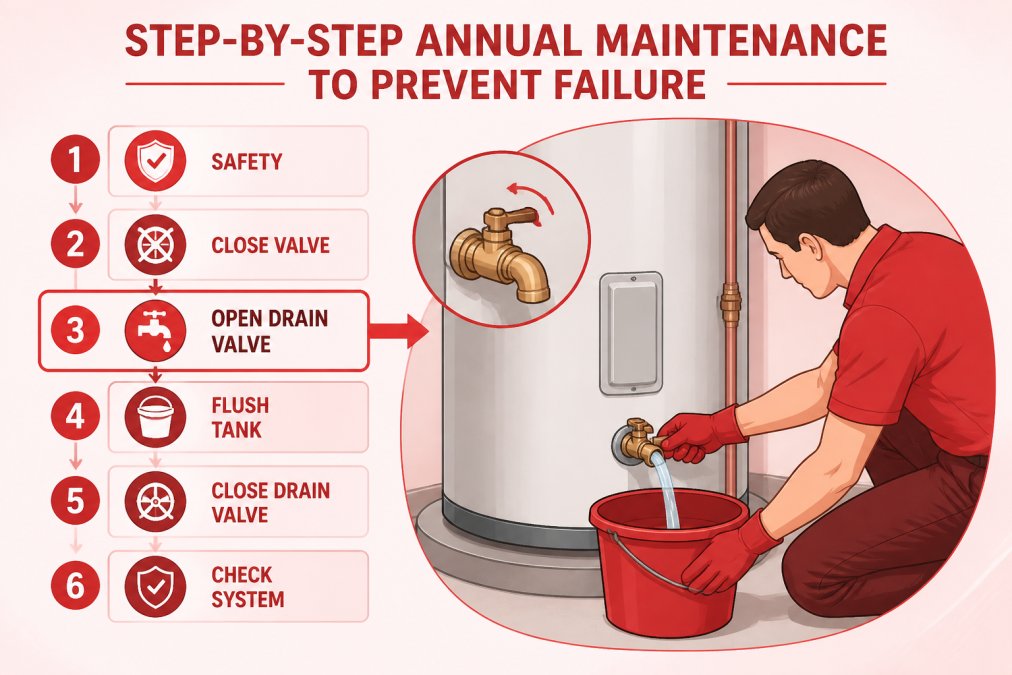
Draining and flushing removes sediment before it hardens.
Inspecting for Corrosion and Leaks
Inspect the tank exterior for rust stains or leaks, check the drain valve and shutoff valve, verify the pressure relief valve discharge pipe is clear, and look for corrosion on pipes and fittings. Tighten loose connections; if you see active corrosion or rust holes, contact a plumber.
Smart Leak Detection and Water Damage Protection
Smart leak detection systems monitor your water heater and shut off water automatically if they sense a leak, sending phone alerts. Benefits include early warning, automatic shutoff, and potential insurance discounts. Installation requires a licensed electrician and plumber. For older homes, the investment pays for itself if it prevents one major water damage claim.
Insurance Implications of Aging Water Heaters
Homeowner’s insurance companies view aging water heaters as significant liability and often have explicit age limits and maintenance requirements. Understanding your policy can mean the difference between a covered claim and a $10,000+ repair bill.
Why Insurers Limit Coverage on Aging Water Heaters
Insurers classify water heaters as predictable-lifespan items; failure rates spike at 8-10 years. Water damage from burst heaters is a common, costly claim ($5,000-$15,000+), so insurers exclude coverage or require replacement by a specific date to reduce exposure.
What Your Policy Actually Says
Approach 1: Age Exclusion, Some policies exclude coverage for water damage from heaters older than a specified age (typically 10, 12, or 15 years), regardless of maintenance history. If your tank fails at or beyond that age, the entire claim can be denied.
How to Find Your Policy’s Water Heater Rules
Contact your insurance agent directly to ask about age limits and maintenance requirements, review your policy document for sections on water damage coverage and exclusions, check your insurer’s website, and request a written summary from your agent. Do not assume your policy covers aging water heaters.
Documentation That Protects Your Coverage
Keep detailed records: drain-and-flush receipts, DIY maintenance logs with photos, professional inspection reports, warranty documentation, and replacement receipts. Store these with your insurance policy for claim documentation.
The Insurance Replacement Trigger
Use your insurer’s age limit to drive replacement timing: at age 8, confirm the limit; at age 9, begin budgeting; at age 10 (if that’s your limit), complete replacement within 30 days; at age 12+, contact your insurer immediately. Check the manufacturer’s label on the tank for the actual age.
Claim Denial Scenarios
Common denial scenarios: age exclusion (tank too old), lack of maintenance documentation (no receipts), professional installation requirement (DIY work not accepted), or failure to replace by deadline (missed the cutoff date).
Insurance Discounts for Proactive Replacement
Some insurers offer premium discounts if you replace your water heater before it reaches the age limit. Discounts typically range from 5-10% on your annual premium. Over 5 years, this can offset 25-50% of the replacement cost.
Your homeowner’s insurance policy likely has an age limit on water heater coverage. If your tank exceeds that age and fails, the insurer can deny the entire claim, leaving you responsible for water damage repairs that can exceed $10,000. Confirm your policy’s age limit and maintenance requirements in writing today. Use that deadline as your replacement trigger, not the tank’s actual failure. Proactive replacement protects both your property and your insurance coverage.
Common Mistakes That Speed Up Failure
Most water heater failures result from neglect. Homeowners skip maintenance, ignore warning signs, or wait too long to replace aging units.
Frequently Asked Questions
What is the normal life expectancy of a water heater in an older home?
Most water heaters last 8 to 12 years, though this depends heavily on water quality, maintenance, and mineral content. In older homes with hard water or poor maintenance history, failure can occur earlier. Annual flushing and anode rod inspection can extend system lifespan by several years. If your water heater is past 10 years old and showing signs of corrosion or sediment buildup, replacement planning should begin soon.
How often should you flush a water heater in an older home?
Flush your water heater annually, or twice yearly if you have hard water or high sediment buildup. Flushing removes scale deposits and sediment that accumulate at the tank bottom, reducing strain on the heating element and burner assembly. Older homes often have harder water, making more frequent flushing necessary. Skip this step and sediment buildup accelerates corrosion and thermal expansion stress, shortening system lifespan significantly.
Can a leaking water heater cause structural damage to a home?
Yes. A slow leak can cause water damage to flooring, subflooring, and structural framing over months. A burst tank creates sudden flooding that damages drywall, insulation, and foundations. Water damage repair costs often exceed $5,000 to $15,000. Installing a floor drain near your water heater, using an emergency shut-off valve, and adding smart leak detection systems can mitigate risk. Check your homeowner’s insurance policy; many insurers require annual water heater maintenance or they may deny damage claims.
What are the early warning signs of a failing water heater?
Watch for discolored water (rust or brown tint), strange noises (popping or rumbling from sediment), visible corrosion on the tank exterior, pooling water around the base, and reduced hot water supply. A faulty pressure relief valve that drips continuously also signals trouble. Temperature fluctuations or a burner that won’t ignite are additional red flags. Any of these signs warrant professional inspection; waiting can lead to sudden failure and water damage.
Comments are closed