

Table of Contents
- Water Heater Installation Cost Breakdown: What Your Quote Should Show
- Water Heater Installation Cost: What Changes With Size
- Tankless Water Heater Installation Cost: Higher Upfront, Different Long Game
- Gas vs Electric: How Fuel Type Splits the Bill
- Reading a Water Heater Replacement Estimate Line by Line
- Water Heater Lifespan and When Replacement Beats Repair
- Permits, Code Compliance, and Costs Beyond a Straight Swap
- Conclusion: Getting a Quote You Can Actually Compare
- Frequently Asked Questions
Last Updated: October 13, 2026
Water Heater Installation Cost Breakdown: What Your Quote Should Show
A water heater installation cost breakdown separates equipment, labour, removal, and permit charges so you can compare quotes on equal terms.
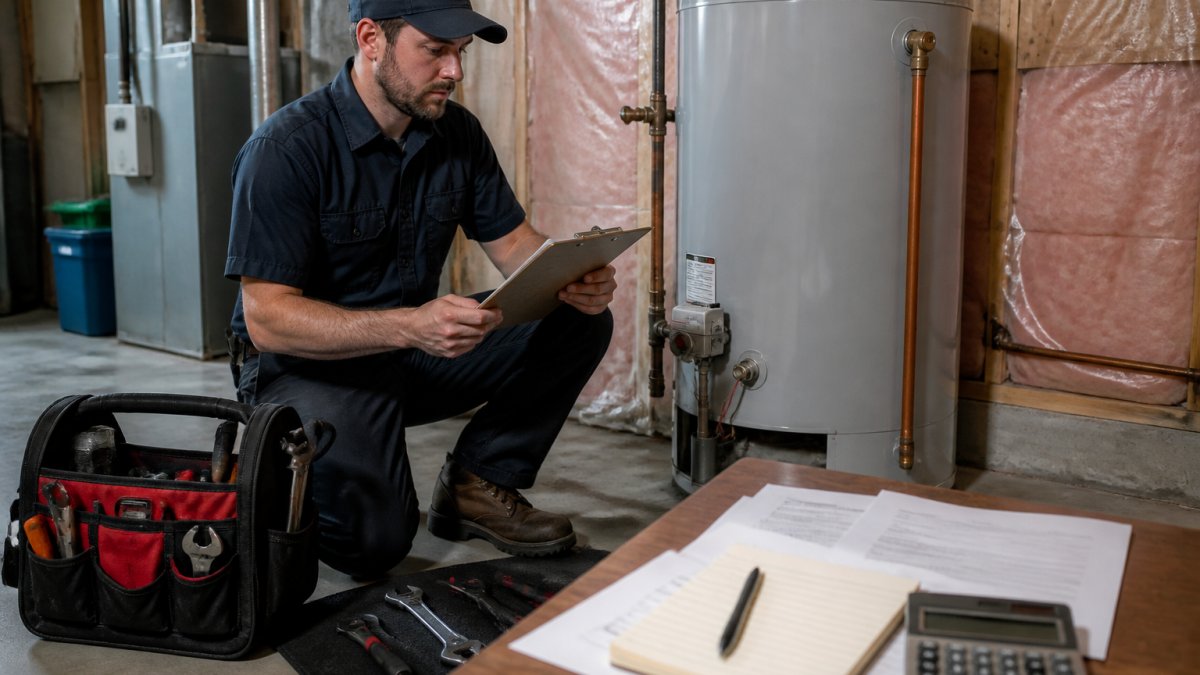
Below, we break down every line a proper water heater installation quote should contain, what changes the total, and how to spot gaps before you sign.
A fair quote lists four things separately: the unit, the labour, the removal and disposal of the old tank, and any permits. If a quote shows one number with no detail, ask for the itemization in writing before you compare it to anything.
Equipment and Unit Price
The unit price is the cost of the water heater itself, and it varies with capacity, fuel type, and efficiency rating.
The unit price is the easiest line to compare and the least important. Two quotes can list the same tank at different prices because one includes a longer warranty or a better anode rod. Ask for the model number, not just the size.
Labour and Installation Charges
Labour covers the time and skill to disconnect the old unit, install the new one, and test it. It changes most between quotes because it depends on access, venting, and code requirements.
A straightforward swap in an open basement takes far less time than a replacement in a tight closet with corroded fittings, and older plumbing adds labour. Our team handles heritage and modern properties, and the labour estimate should always state what is included: disconnection, installation, gas or electrical hookup, and testing.
Removal and Disposal of the Old Unit
Removal and disposal covers hauling the old tank out and recycling it properly. Many quotes leave this line out entirely, then add it later as a surprise charge.
Ask directly whether the quote includes removal. A tank full of sediment is heavy, and getting it up basement stairs is real work. A quote that omits this line is not cheaper.
Water Heater Installation Cost: What Changes With Size
A water heater installation costs more than a smaller unit, but the tank itself is only part of the jump. The rest comes from fittings, vent, weight, and access, the lines that show up on an itemized quote and disappear on a lump-sum one.
Size drives cost through four mechanisms:
- Tank and materials. A larger tank uses larger diameter fittings, a longer dip tube, and often a bigger drain valve, small line items that add up.
- Recovery rate and first-hour rating. A larger tank is usually paired with a higher-output burner or element to keep up with demand, changing the gas input (BTU/h) or electrical draw (watts) and therefore the venting or circuit requirements.
- Venting. A higher-BTU gas unit may need a larger vent connector or different vent category. If the existing vent is undersized, the vent line on the quote grows.
| Tank Capacity | Typical Household | What Actually Pushes the Price Up |
|---|---|---|
| 30-gallon | 1-2 people, small home | Smallest unit, standard fittings, easiest removal |
| 40-gallon | 2-3 people | Standard fittings, common vent size, common circuit |
| 50-gallon | 3-4 people, multiple bathrooms | Larger fittings, higher input, heavier removal, possible vent upsizing |
| 80-gallon | 5+ people, high demand | Taller and heavier unit, clearance and venting changes, often a dedicated circuit or larger gas line |
The capacity you need depends on peak-hour demand, not headcount. Two numbers on the unit label tell you whether a tank is right: the first-hour rating (FHR), how much hot water it delivers in the first hour of heavy use, and the recovery rate, how fast it reheats.
When you compare quotes for different tank sizes, ask each contractor to state the model number, the first-hour rating, and the recovery rate on the unit line. Two 50-gallon tanks with different recovery rates are not the same product, and the cheaper quote may be the smaller-capacity unit in disguise.
Tankless Water Heater Installation Cost: Higher Upfront, Different Long Game
Tankless water heater installation costs more upfront than a tank replacement, but the equipment lasts longer and heats water on demand.
The long game is where tankless earns its keep: no standing tank losing heat around the clock, so operating costs can be lower over the unit’s life.
If your home already has the right infrastructure, tankless is worth serious consideration; if not, the added work can change the math.
Gas vs Electric: How Fuel Type Splits the Bill
Fuel type splits the bill in two ways: unit cost and installation work.
The fuel you already have often decides this. Switching from electric to gas means running a gas line, a significant added cost; switching from gas to electric means capping the gas line and possibly upgrading the electrical panel.
Staying with your existing fuel type is almost always cheaper, unless you are already renovating and the added line cost is absorbed into a larger project.
Never let anyone install a gas water heater without confirming the venting meets current code. Improper venting is a carbon monoxide risk, and fixing it after the fact costs far more than doing it right the first time.
Reading a Water Heater Replacement Estimate Line by Line
A water heater replacement estimate should let you compare two quotes without guessing. Use this checklist to read any estimate before you sign.
- Unit line states the model number, capacity, and warranty length
- Labour line states what is included: disconnect, install, hookup, test
- Removal and disposal of the old unit is listed separately
If a quote is missing three or more of these lines, ask for a revised version. A plumber who will not itemize is a plumber who will surprise you later.
Photograph your current water heater’s label before anyone quotes the job. The model number, capacity, and fuel type are all on it, and having them ready means every quote you get is for the same specification.
Water Heater Lifespan and When Replacement Beats Repair
The typical water heater lifespan is 8 to 12 years for a tank unit and up to 20 years for a well-maintained tankless model. According to the Technical Standards and Safety Authority (TSSA) ([2026]), proper installation and maintenance are key to longevity.
Repair beats replacement when the unit is young and the fault is a single cheap part, like a heating element or thermostat. However, industry benchmarks suggest that for units over 10 years old, the cost of repeated repairs often outweighs the investment in a new unit.
The decision also depends on your plans for the home. If you are staying long term, replacing an aging tank on your schedule beats an emergency replacement at the worst possible time.
Permits, Code Compliance, and Costs Beyond a Straight Swap
Permits and code compliance are the lines most homeowners never see until a surprise charge, and the lines most competitors skip. This is what separates a complete estimate from a base price.
When a permit is actually required
Permit rules are set locally, so the trigger varies by municipality. A common pattern is:
- Like-for-like replacement of the same fuel type and capacity in the same location often still requires a permit, because the work involves a gas connection or an electrical disconnect. Some jurisdictions waive the permit for a true like-for-like swap; many do not.
- Fuel type change (electric to gas, or gas to electric) almost always requires a permit, because it introduces a new gas line or a new circuit.
- Relocation of the unit to a different spot requires a permit, because the venting, gas line, and drain pan all change.
The practical rule: if the work touches gas, electrical, or venting, assume a permit is needed until the contractor confirms otherwise in writing. Provincial building codes and municipal bylaws dictate these requirements.
What code compliance actually changes
Code is not a single document. Water heater installations are governed by the plumbing code, the gas code, the electrical code, and the building code, and the applicable edition depends on your province or territory. A few requirements come up repeatedly on replacement jobs:
- Temperature and pressure relief valve must be rated for the unit and piped to a safe discharge point. An old valve that is reused is a common inspection failure.
- Expansion tank or thermal expansion control is required in many closed plumbing systems, especially where a backflow preventer or pressure-reducing valve is installed. This is a common requirement under provincial plumbing codes.
- Drain pan and discharge is required where a leak would cause damage, and the pan drain must run to an approved location. This is often mandated by local bylaws to prevent water damage.
How the permit and inspection line appears on a quote
A complete quote should show the permit fee as its own line, or state explicitly that the permit is included in the labour line. It should also state who pulls the permit, the contractor, not the homeowner.
Inspection is usually a separate visit after the install. The contractor should schedule it and be present. If a quote does not mention inspection, ask whether it is included.
A quote that says “no permit needed” for a gas or electrical water heater change is a red flag. Either the contractor does not know the local rules or is planning to skip the permit. Both outcomes put the homeowner on the hook if something goes wrong.
How to verify the permit was pulled
Ask for the permit number before work starts. Most municipalities publish a permit search or phone line to confirm the permit exists and matches the address and scope. If the contractor cannot produce one, the work is unpermitted, which can affect insurance coverage and resale.
Scenarios beyond a straight swap
A like-for-like swap is the simplest and cheapest scenario. Anything beyond it adds cost, and each item below should appear as its own line:
- Relocating the unit to a different spot
- Upgrading venting to meet current code
- Adding or resizing a gas line
These are not upsells but code requirements a licensed plumber is obligated to address. A quote that ignores them is incomplete or planning to cut corners, and fixing unpermitted or non-compliant work later almost always costs more than doing it right the first time.
Conclusion: Getting a Quote You Can Actually Compare
The hardest part of a water heater replacement is not the work, it is getting two quotes you can hold side by side. Demand an itemized breakdown every time: unit, labour, removal, permits, and any additional work.
Indy Plumbing has spent over 13 years installing and replacing water heaters for homeowners and businesses, with transparent, upfront pricing and no hidden fees. Visit Indy Plumbing for a quote.
Frequently Asked Questions
What is the average lifespan of a water heater?
Most tank-style water heaters last around 8 to 12 years, while tankless units often run 15 to 20 years with regular descaling. Lifespan depends on water quality, how hard the unit works, and whether it gets annual maintenance. If your tank is past 10 years old and you are facing a repair, putting that money toward a replacement usually makes more sense than fixing a unit near the end of its water heater lifespan.
What factors affect the cost of water heater installation?
The biggest cost factors are tank capacity, fuel type (natural gas versus electricity), and installation complexity. A like-for-like swap in an accessible spot is the simplest job. Add venting changes, a new gas line, electrical upgrades, or a relocation to another floor and the labour and materials climb. Permits, old unit disposal, and any code compliance work also shift the final number. Your water heater installation cost breakdown should list each of these separately.
How much does it cost to install a 50-gallon water heater?
A 50-gallon unit costs more than a 40-gallon model because you are paying for a larger tank and, often, more labour to move and position it. The exact 50-gallon water heater installation cost depends on whether it is gas or electric, how accessible the location is, and what venting or wiring work is needed. Ask for an itemized quote that separates equipment, labour, and disposal so you can compare offers fairly.
Is it cheaper to repair or replace a water heater?
A single repair, such as a heating element or thermocouple, is usually cheaper than a full replacement. But if the tank itself is leaking, the unit is over 10 years old, or you have paid for two repairs in three years, replacement wins on lifetime cost. A leaking tank cannot be patched reliably, and repeated repairs on an aging unit rarely pay off. Get a water heater replacement estimate before committing to another fix.
How much does it cost to switch from a tank to a tankless water heater?
Switching to tankless usually costs more than a standard replacement because it is not a like-for-like swap. You may need a larger gas line, new venting, and upgraded electrical work, all of which add to the tankless water heater installation cost. The trade-off is a longer lifespan and lower standby energy losses. Ask for a quote that itemizes the extra work so you can see exactly what the switch requires.
Comments are closed