

Table of Contents
- Why Milton Homeowners Are Replacing Water Heaters in 2026
- How to Choose the Right Water Heater Size for Your Home
- Tankless vs Tank Water Heater Pros and Cons
- Cost of Water Heater Installation Ontario: What Drives Your Quote
- Permits, TSSA Rules and Why DIY Water Heater Installation Is Risky
- What to Expect From Professional Water Heater Installation Services
- Repair or Replace? Maintenance That Extends Water Heater Lifespan
- Frequently Asked Questions
Last Updated: September 21, 2026
Why Milton Homeowners Are Replacing Water Heaters in 2026
Water heater installation in Milton has shifted from a routine swap to a decision point. Older storage tanks are reaching end of life, hydro costs keep climbing, and federal efficiency rules have changed what can legally be sold. At Indy Plumbing, we field more replacement calls each year from homeowners who want a system that matches how their family uses hot water.
How to Choose the Right Water Heater Size for Your Home
Sizing is the step most homeowners skip, and it causes the most regret. An undersized unit runs out of hot water mid-shower; an oversized one wastes energy. Getting it right takes two numbers: peak hour demand and household flow rate.
Calculate Your Peak Hour Hot Water Demand
Peak hour demand is the total hot water your household could use in your busiest 60 minutes. List fixtures likely to run at once, then assign each a typical draw:
- Shower: 10 litres per minute
- Bathroom faucet: 5 litres per minute
- Kitchen faucet: 5 litres per minute
- Dishwasher: 6 litres per minute
- Clothes washer: 8 litres per minute
Match BTU Capacity and Flow Rate to Your Household
For tankless units, the deciding number is flow rate, measured in litres per minute at a given temperature rise. Incoming groundwater here is cold in winter, so heating it to 49°C takes serious output. A gas tankless unit rated around 8 to 10 litres per minute at that rise suits one to two bathrooms. Electric tankless models draw enormous amperage and often require a panel upgrade, which is why gas remains the practical choice for most homes here.
Check the first-hour rating on the tank’s yellow EnerGuide label, not the tank capacity. Two 190-litre tanks from different brands can deliver very different first-hour ratings depending on recovery speed.
Tankless vs Tank Water Heater Pros and Cons
The tankless versus tank debate comes down to upfront cost against long-term convenience. Tankless units heat water on demand, never run out, and last roughly twice as long. Tanks cost less to buy and install, deliver hot water instantly, and are simpler to service. Neither wins universally.
| Factor | Tank | Tankless |
|---|---|---|
| Upfront cost | Lower | Higher |
| Lifespan | 8-12 years | 15-20 years |
| Hot water supply | Limited by tank | Unlimited |
| Space needed | Larger footprint | Wall-mounted |
| Maintenance | Annual flush | Annual descaling |
| Retrofitting | Minimal | Gas, venting, electrical work |
Venting, Gas Lines and Electrical Upgrades to Expect
Tankless installs are rarely drop-in replacements. Most condensing models need a new PVC or stainless vent run, and older homes often need a larger gas line. Homes on a 100-amp panel may need an upgrade for an electric tankless unit. These extras are why two quotes for the same model can differ by a wide margin.
Cost of Water Heater Installation Ontario: What Drives Your Quote
The cost of water heater installation Ontario homeowners pay is not a single number, it is the sum of five line items that vary by house. Understanding each lets you compare quotes apples to apples instead of guessing why one contractor is $800 cheaper.
The Five Cost Drivers, Broken Down
1. Unit type and capacity. A standard atmospheric storage tank is the least expensive hardware. A high-efficiency condensing tank costs more upfront but recovers faster. A heat pump water heater has the highest sticker price but draws roughly a third of the electricity of a resistance-electric tank. Tankless units sit between the two on hardware cost but add the most installation labor.
Why Two Quotes for the Same Model Differ
A low quote often excludes venting, gas line work, permit fees, or disposal. A high quote may include a panel upgrade or a longer vent run the other contractor missed on a phone estimate. The only reliable comparison is a written quote that itemizes all five drivers.
Ask every contractor to quote the same model number and to list venting, gas line, electrical, permit and disposal as separate lines. If a quote bundles everything into one number, you cannot tell what is included.
Rebates and Energy-Efficient Options That Lower the Bill
Energy-efficient models can offset part of the upfront cost. ENERGY STAR certified heat pump water heaters and high-efficiency condensing units qualify for federal and provincial rebate programs, though amounts and eligibility change regularly. Check the Canada Greener Homes initiative and your local utility’s current offers before you buy, and confirm the model qualifies before installation, since rebates generally cannot be claimed retroactively on ineligible units.
Get three written quotes that itemize unit, venting, gas line, electrical, permit and disposal. Compare the line items, not the totals. A cheap total with missing lines is not a cheaper job, it is an incomplete quote.
Permits, TSSA Rules and Why DIY Water Heater Installation Is Risky
Water heater installation in Ontario is regulated work, and the permit process confuses most homeowners because two different authorities are involved. Understanding who does what removes the guesswork.
Who Regulates What
TSSA (Technical Standards and Safety Authority) regulates the gas side. Any gas-fired water heater, tank or tankless, must be installed by a licensed gas technician and inspected for compliance. TSSA does not issue the municipal permit; it enforces the gas code through licensed technicians and inspection.
What the Permit Process Actually Looks Like
- The licensed contractor pulls the gas permit before work begins.
- The old unit is drained, disconnected and removed.
- The new unit is set, connected, vented and tested for leaks.
- The contractor books the inspection.
- The inspector verifies venting, gas supply, relief valve and clearances.
- The permit is closed, and the homeowner keeps the documentation.
If electrical work is involved, the ESA inspection runs in parallel or after the gas inspection, depending on the scope.
Why DIY and Handyman Installs Fail
The risks of skipping the permit are concrete. An improperly vented gas water heater can leak carbon monoxide into a home. A tank installed without a properly sized pressure relief valve can become a pressure vessel. A gas connection made without a leak test can fail silently. And an unpermitted install can void your home insurance if a failure causes water or fire damage, insurers routinely ask for the permit and inspection record after a claim.
A common mistake is buying a unit online and having a general handyman hook it up. If the venting or gas connection is wrong, the TSSA inspection will fail, and you will pay a licensed technician to redo the work anyway, plus the original purchase price. The permit is not a formality; it is the record that protects your insurance coverage.
What to Ask Before You Hire
Ask the contractor for their TSSA gas technician licence number, confirm they will pull the permit in their name, and ask who books the inspection. A legitimate installer answers all three without hesitation. If a quote excludes the permit or says “you don’t need one for a swap,” treat that as a red flag, the permit requirement follows the gas connection, not the job size.
Two authorities, two permits: TSSA-licensed gas work plus a municipal permit and inspection for the gas side, and an ESA permit if electrical circuits change. Your contractor should handle both and leave you with the closed-permit documentation.
What to Expect From Professional Water Heater Installation Services
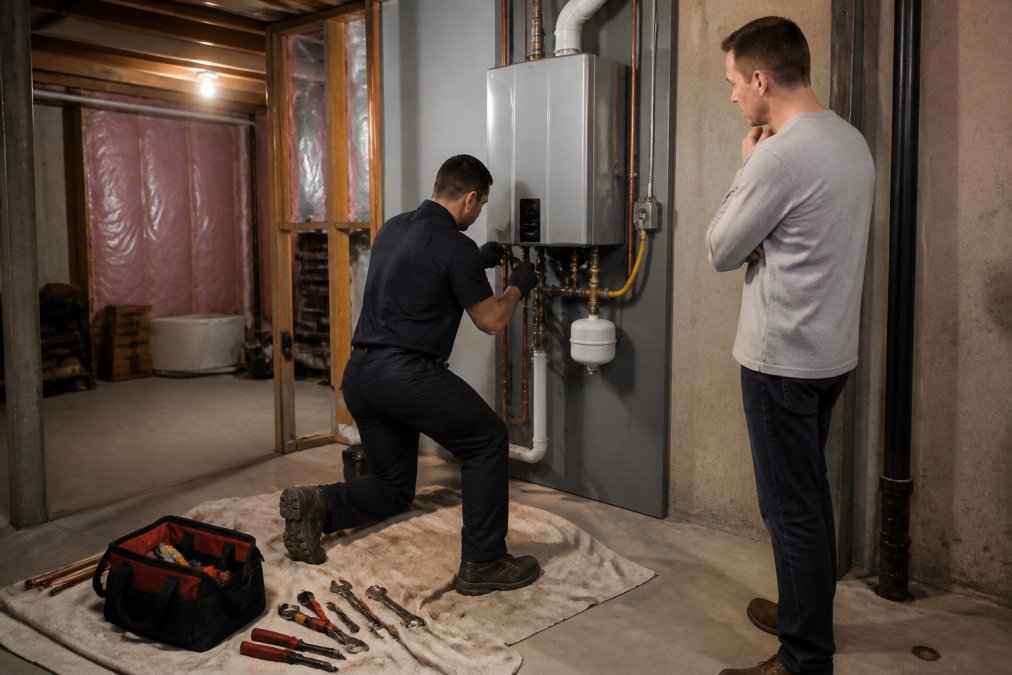
A professional install follows a set sequence: shut off gas or power, drain and disconnect the old unit, inspect venting and connections, set the new unit, reconnect supply lines, test for leaks, and confirm the pressure relief valve and temperature settings. Most standard swaps take two to four hours; tankless conversions can run a full day.
Repair or Replace? Maintenance That Extends Water Heater Lifespan
Repair usually wins when the unit is under eight years old, the problem is a single failed part, and the tank is sound. Replacement makes more sense once the tank is leaking, the unit is past its expected lifespan, or a repair bill approaches half the cost of a new install.
Frequently Asked Questions
How much does water heater installation cost in Ontario?
The cost of water heater installation Ontario homeowners pay depends on the unit type, fuel source and any upgrades needed. A straightforward tank swap costs less than a tankless conversion, which may require new venting, a larger gas line or an electrical circuit. Labour, permit fees and disposal of the old unit are usually itemized separately. Indy Plumbing publishes upfront pricing on its website, so you can see the full breakdown before booking.
Do I need a permit for water heater installation in Ontario?
Yes, in most Ontario municipalities a permit is required for a new water heater installation, and gas connections must be completed by a TSSA-certified technician. Milton follows this process, and the permit covers the inspection that confirms safe venting, gas connections and pressure relief. Skipping the permit can void your home insurance and create problems at resale. A licensed installer handles the paperwork as part of the job.
Are there rebates for energy-efficient water heaters in Ontario?
Rebates for high-efficiency water heaters, including heat pump models and some Energy Star certified units, are available through Ontario and federal programs, though amounts and eligibility change. Your installer should confirm current incentives, provide the model number and efficiency rating, and supply the invoice you need to apply. Ask for this in writing before installation so nothing is missed.
Should I choose a tankless or traditional tank water heater?
Tankless units save space and deliver continuous hot water, but they cost more upfront and need adequate gas supply and venting. Storage tank systems cost less to install and suit households with steady demand. For a family of four, a correctly sized tank often costs less overall, while a tankless model pays off in homes with high simultaneous demand. A professional consultation can match the choice to your usage.
Replacing a water heater is one of those jobs where the cheapest quote often costs the most later. A correctly sized, properly permitted install protects your home, your insurance, and your hot water supply for the next decade. Indy Plumbing brings over 13 years of experience, licensed and insured technicians, transparent upfront pricing, and 24/7 emergency support to every job. Get started with Indy Plumbing and schedule a water heater installation you won’t have to think about again.
Comments are closed