

Table of Contents
- Water Heater Leaking From the Bottom: First Steps
- How to Turn Off a Leaking Water Heater
- Tracing the Leak: Is It the Tank or a Connection?
- Water Heater Leaking From the Drain Valve
- Water Heater Leaking From the Pressure Relief Valve
- Water Heater Leaking Repair or Replacement?
- Frequently Asked Questions
Last Updated: October 14, 2026
Water Heater Leaking From the Bottom: First Steps
A water heater leaking from the bottom is a plumbing emergency. Water can spread across the floor in minutes, and a small puddle often signals a bigger problem inside the tank. This guide shows you exactly what to do, in order, before a plumber arrives.
The first thing to know: a leak from the bottom is rarely just a loose fitting. It usually means the tank itself has failed. That changes what you do next.
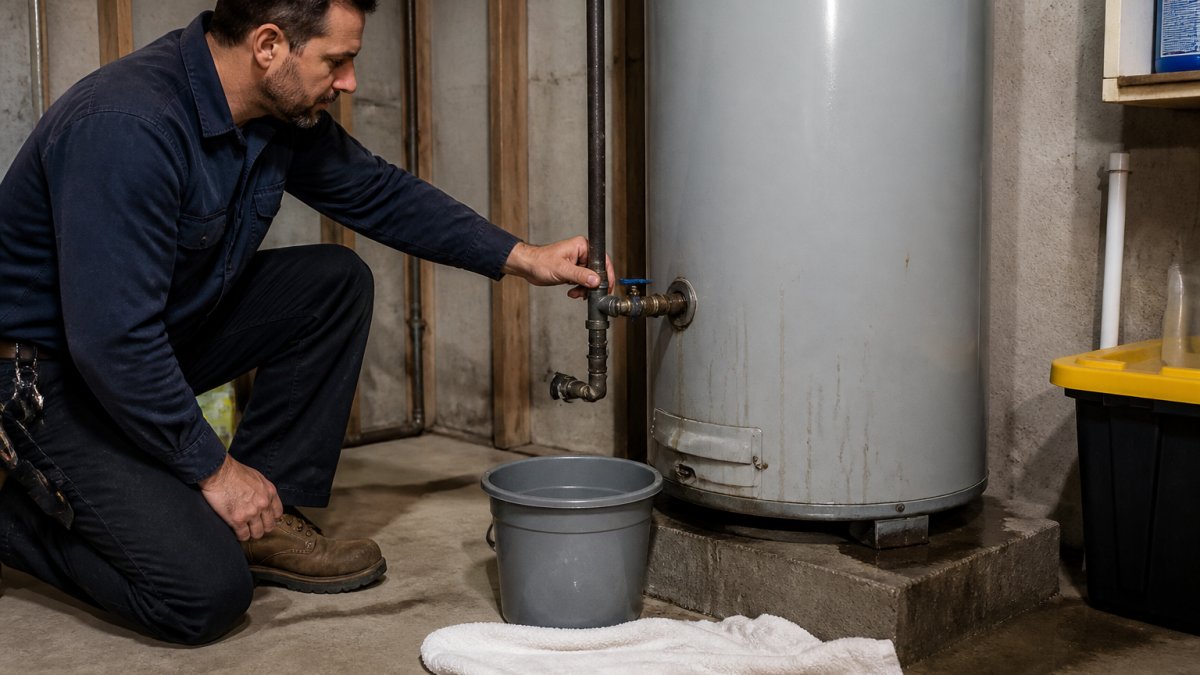
A Safe, Ordered Emergency Checklist
Follow these steps in order. Do not skip ahead.
- Turn off the cold-water supply valve on top of the tank.
- Shut off power or gas to the unit.
- Open a hot-water tap to drain pressure.
- Move valuables and electronics away from the water.
- Soak up standing water with towels or a wet vacuum.
- Call a licensed plumber for same-day service.
Never touch an electric water heater’s wiring or a gas unit’s burner area while the floor is wet. Water plus live power or an open flame is a serious hazard. Shut off the supply first.
How to Turn Off a Leaking Water Heater
Turning off a leaking water heater means closing the cold-water supply valve and cutting power or gas to the unit. This stops more water from entering the tank and removes the risk of shock or fire. The shutoffs differ between electric and gas models, so check which type you have before you start.
Electric vs. Gas: Which Shutoffs Apply
Electric water heaters rely on a circuit breaker. Find your panel and flip the breaker labeled for the water heater.
Gas water heaters have a gas control valve near the bottom. Turn the dial to “Off” or “Pilot.”
| Heater Type | Water Shutoff | Power/Gas Shutoff |
|---|---|---|
| Electric | Cold-water valve on top | Circuit breaker in panel |
| Gas | Cold-water valve on top | Gas control dial to Off |
Tracing the Leak: Is It the Tank or a Connection?
A leak from the bottom is either a failed tank or a loose connection. The difference matters, because one is repairable and the other is not. Dry the area, then watch where water reappears.
- Tank failure: water seeps from the base or shell, often with rust stains.
- Loose fitting: water drips from the inlet or outlet connection on top.
- Condensation: a few drops on a cold tank, not a steady leak.
Tie a dry paper towel around each fitting and check it after ten minutes. The wet one points to your leak source.
Water Heater Leaking From the Drain Valve
A water heater leaking from the drain valve is one of the few leaks you can often fix yourself. The drain valve sits at the bottom of the tank and empties it during maintenance. Over time, its washer wears out or sediment blocks it open.
Try tightening the valve by hand first. If it still drips, the drain valve washer likely needs replacing. This is a cheap part, but the tank must be drained first, so many homeowners call a plumber rather than risk a bigger spill.
Water Heater Leaking From the Pressure Relief Valve
A water heater leaking from the pressure relief valve usually points to too much pressure or heat inside the tank. The temperature and pressure relief valve, often called the T&P valve, is a safety device. It opens when pressure climbs too high.
Common causes include:
- Excessive temperature from a faulty thermostat
- High water pressure in the home
- Sediment buildup trapping heat at the bottom
Do not plug or cap a T&P valve. It protects the tank from bursting.
Water Heater Leaking Repair or Replacement?
A water heater leaking repair or replacement decision comes down to where the water is coming from, the age and condition of the tank, and the scope of the repair. Loose fittings, drain valves, and pressure relief valves can be repaired. A leaking tank cannot. Once the internal tank corrodes, the unit is done.
A Simple Decision Path
Work through these questions in order:
- Where is the water coming from? If the base or shell of the tank is wet and rust is visible, the tank has failed. Stop here and plan for replacement.
- Is the leak at a valve or connection? Drain valves, T&P valves, inlet and outlet fittings, and unions are serviceable parts. Repair is usually worth trying.
- How old is the tank? Most residential storage tanks have a service life of roughly 8 to 12 years, though water quality and maintenance shift that range. A tank near or past that window with any leak is a poor repair candidate.
- How much water is escaping? A steady stream or a leak that returns within hours of drying points to a structural failure. An occasional drip at a valve is a repair.
- Is the tank still under warranty? Check the rating plate for the manufacture date and model number, then compare it against your warranty documentation.
If the answers point to a failed tank, replacement is the only safe option. If they point to a valve or fitting, a repair call is reasonable.
Costs, Warranty, and Insurance Considerations
Repair and replacement costs vary by unit size, fuel type, parts, and labor, so a licensed plumber should quote each job after inspecting the tank. As a general planning guide, a minor repair such as a drain valve or T&P valve replacement is typically a small fraction of the cost of a full tank replacement, while a same-day replacement of a standard residential tank is a larger, multi-part expense that includes the unit, labor, and disposal of the old tank. Ask for a written quote that separates parts, labor, and any permit or disposal fees.
Warranty. Most tank warranties are prorated: the manufacturer may cover part or all of the tank itself within a set window from the manufacture date, but labor is usually the homeowner’s responsibility. Keep your purchase receipt and the rating plate information. A failed tank inside the warranty window can still leave you paying for installation.
Insurance. Home insurance may respond to sudden and accidental water damage, such as a tank that bursts and floods a finished basement. It typically does not cover damage from a slow leak you knew about and did not address, and it generally does not cover the failed water heater itself. Review your policy wording and document the date you first noticed the leak.
Prevention. Routine maintenance extends tank life and reduces the chance of a bottom leak. Flush sediment from the tank annually, test the T&P valve by lifting and releasing its lever, and have the anode rod inspected every few years. Sediment buildup traps heat at the bottom of the tank and accelerates corrosion, which is one of the most common causes of a leak at the base.
The single most useful fact here: a leak from the tank base means replacement, not repair. Everything else can usually be fixed. Check the warranty and your insurance policy before you authorize work, and budget for labor even when the tank itself is covered.
Frequently Asked Questions
Why is my water heater leaking from the bottom?
Most bottom leaks come from internal tank corrosion, a worn drain valve washer, a failing temperature and pressure relief valve, or loose inlet and outlet connections. Rust streaks and water pooling directly under the tank usually point to a failed tank, which cannot be patched. If the water appears only after heavy use, condensation or excess pressure may be the cause instead.
Is a water heater leaking from the bottom dangerous?
A tank leak itself is mostly a water damage risk, but the combination of water and electricity or gas is the real hazard. Water near the power supply can cause shocks or short circuits, and a corroded gas unit can develop carbon monoxide issues. Shut off the water and power or gas before inspecting, and call a licensed plumber if you smell gas.
Can a water heater leaking from the bottom be repaired?
It depends on the source. Drain valve leaks, loose fittings, and faulty T&P valves are repairable with a new washer, tightened connection, or replacement valve. A leaking tank from internal corrosion cannot be repaired and needs replacement. If the tank is over 10 years old and rusting, replacement is usually the smarter spend.
How long does a water heater usually last?
Most tank water heaters last 8 to 12 years with regular maintenance, including annual flushing to remove sediment buildup. Hard water shortens that lifespan. If your unit is past 10 years old and leaking from the tank, replacement is typically more cost-effective than repeated repairs.
A leaking water heater gets worse by the hour, and water damage costs more than the fix. Indy Plumbing offers 24/7 emergency support, licensed and insured plumbers, and transparent, upfront pricing with no hidden fees. We install durable, top-grade water heaters and clean up after every job. Schedule service with Indy Plumbing today and stop the leak before it spreads.
Comments are closed