

Table of Contents
- Understanding Well Pumps: Submersible vs. Jet Pumps
- How to Choose the Right Well Pump for Your Property
- Signs of a Failing Well Pump
- Well Pump Replacement Cost and DIY vs. Professional Installation
- Well Pump Maintenance Tips for Long-Term Performance
- Energy Efficiency and Power Consumption
- Frequently Asked Questions
Last Updated: September 18, 2026
Understanding Well Pumps: Submersible vs. Jet Pumps
Well pumps are the backbone of any private water supply system. They pull water from underground sources and push it into your home’s plumbing network. The two most common types, submersible and jet pumps, each serve different well depths and property configurations. Your choice depends on how deep your well runs, how much water you need, and your budget for installation and maintenance.
Submersible pumps sit inside the well casing itself, fully submerged in water. This design eliminates the need for a surface-mounted motor and reduces noise significantly. Jet pumps, by contrast, sit above ground and use suction to draw water up from shallow sources. Understanding these differences is critical because the wrong choice can lead to inadequate water pressure, higher energy bills, or premature pump failure.
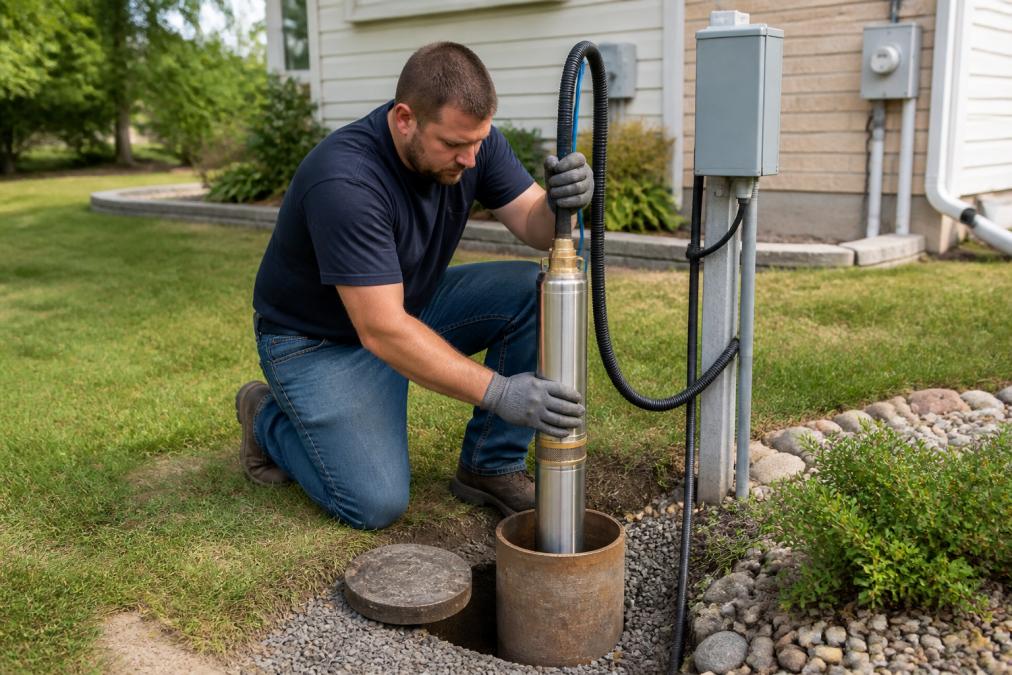
Submersible Pumps for Deep Wells
Submersible pumps excel in deep wells, typically those extending 9 metres or deeper. The motor sits at the bottom of the well casing, pushing water upward through a discharge line. This design eliminates the pressure limitations that plague shallow-well systems. A submersible pump can handle total dynamic head (the total height the pump must push water against gravity and friction) far more efficiently than surface-mounted alternatives.
The impeller inside a submersible pump rotates to move water upward. Cast iron or stainless steel construction resists corrosion from prolonged water contact. Most submersible pumps run on 240-volt power, though some residential models operate at 120 volts. Flow rates typically range from 38 to 114 litres per minute for household systems, though larger models can deliver significantly more.
Common mistake: many homeowners assume a submersible pump requires minimal maintenance. In reality, sediment buildup, mineral deposits, and electrical corrosion demand regular attention. Water quality directly affects pump longevity; hard water or high iron content accelerates wear on internal components.
Jet Pumps for Shallow Wells
Jet pumps work best for shallow wells under 9 metres deep. They mount above ground near your pressure tank and rely on atmospheric pressure to pull water upward. A jet pump uses a venturi effect: water exits a small nozzle at high velocity, creating suction that draws more water into the system.
The main advantage is accessibility. When maintenance is needed, you don’t have to pull the pump from the well. Installation costs run lower because no submersion equipment is required. For properties with older wells or limited budget, this matters.
The drawback is depth limitation. Jet pumps cannot reliably lift water from depths beyond 9 metres because atmospheric pressure (about 14.7 pounds per square inch at sea level) becomes insufficient. Trying to force a jet pump deeper than its rated capacity leads to poor flow rates, reduced water pressure, and motor strain.
How to Choose the Right Well Pump for Your Property
Selecting the correct well pump hinges on three factors: well depth, household water demand, and water quality. Skip any one of these, and you’ll end up with a system that either underperforms or fails prematurely.
Well Depth and Installation Requirements
Your well depth is the first decision point. If your well is shallower than 9 metres, a jet pump is viable and often cheaper to install. If your well exceeds 9 metres, a submersible pump becomes necessary. Many properties in regions with deeper aquifers require submersible systems from the outset.
Installation depth also affects pressure tank sizing. A deeper well means the pump must work harder to maintain consistent water pressure. Your pressure switch, the device that turns the pump on and off based on tank pressure, needs proper calibration for your specific setup.
Well casing diameter matters too. Most residential wells use 10-centimetre or 15-centimetre casing. A submersible pump must fit inside this casing with clearance for water flow around the motor. Jet pumps don’t face this constraint since they sit on the surface.
Pump Sizing and Flow Rate Calculations
Flow rate determines whether your household gets adequate water pressure during peak demand. Flow rate is measured in litres per minute (LPM). A typical family of four needs 45-57 LPM for comfortable showers, dishwashing, and laundry simultaneously.
Calculate your household demand by adding up simultaneous uses: shower (9.5 LPM), toilet (5.7 LPM), kitchen sink (7.6 LPM), washing machine (7.6 LPM). If you anticipate multiple simultaneous uses, size your pump accordingly. Undersizing creates frustration; oversizing wastes energy and money.
Total dynamic head (TDH) is the second calculation. TDH accounts for well depth, elevation changes, friction loss in pipes, and pressure tank requirements. A 40-PSI pressure switch on your tank adds to TDH. A 30-metre well adds 30 metres to TDH. Friction loss in 150 metres of discharge line might add another 6 metres. Sum these to find your true TDH requirement, then select a pump rated to handle it.
Signs of a Failing Well Pump
Water pressure fluctuations signal pump trouble. If your pressure swings wildly, strong one moment, weak the next, the pump may be losing prime or the pressure tank may be waterlogged. A waterlogged tank means the air charge inside has been displaced by water, eliminating the cushion that maintains steady pressure.
Reduced flow rate is another red flag.
Well Pump Replacement Cost and DIY vs. Professional Installation
Replacing a well pump involves electrical work, pressure calibration, and depth calculations that carry real financial and safety consequences. Understanding the true cost of DIY versus professional installation helps homeowners make informed decisions rather than defaulting to either extreme.
Cost Breakdown: What You’re Actually Paying For
A submersible pump unit alone costs $400-$1,200 depending on horsepower and materials. A jet pump runs $300-$800. But the pump is only 30-40% of the total replacement cost.
Professional installation typically includes:
- Well service work (pulling the old pump, inspecting casing): $200-$400
- Electrical connections and inspection (licensed electrician required by code): $300-$600
- Pressure tank replacement or servicing: $200-$500
- Pressure switch calibration and testing: $100-$200
- Labor and travel: $400-$800
The Real Risk of DIY Installation
Electrical code violations are the most common DIY failure. Well pump circuits require dedicated breakers, proper grounding, and weatherproof connections. A miswired pump can damage the motor, create shock hazards, or void your home insurance. Licensed electricians know local code requirements; homeowners rarely do.
When DIY Makes Sense (It’s Rare)
DIY is defensible only for pressure tank maintenance or replacing a pressure switch on an existing, properly functioning system, and only if you have basic plumbing knowledge and access to a pressure gauge. Even then, mistakes are costly.
DIY is not appropriate for:
- Initial pump installation
- Pulling a pump from the well (requires specialized equipment)
- Electrical connections (code violation risk)
- Pressure tank replacement
- Any work involving the well casing
Cost-Benefit: When Professional Installation Pays for Itself
A professional installation through proper sizing, calibration, and code compliance can contribute to extending pump life. This can lead to savings in future replacement costs.
Well Pump Maintenance Tips for Long-Term Performance
Regular maintenance prevents emergency failures. Inspect your pressure tank annually for corrosion or leaks. Test your pressure switch to confirm it’s activating at the correct PSI. Check the discharge line for leaks or damage.
Water Quality and Pump Longevity
Water quality directly determines how long your pump survives. Soft, clean water with minimal sediment can contribute to a longer pump lifespan. Hard water, high iron, or sandy sediment can reduce that lifespan.
Smart Pump Technology and Monitoring
Modern well pump systems include pressure monitoring and automatic shut-off features. Some systems alert homeowners to pressure drops or flow anomalies via smartphone apps. This early warning allows intervention before catastrophic failure.
Energy Efficiency and Power Consumption
Well pump motors consume significant household electricity. A typical 1-horsepower submersible pump running continuously uses roughly 750 watts. Most residential systems cycle on and off based on tank pressure, so actual consumption depends on household water usage and pressure tank size.
| Well Pump Comparison | Submersible | Jet Pump |
|---|---|---|
| Best Well Depth | 9+ metres | Under 9 metres |
| Installation Location | Inside well casing | Above ground |
| Typical Flow Rate | 38-114 LPM | 19-76 LPM |
| Motor Horsepower | 0.75-2 HP | 0.5-1.5 HP |
| Installation Cost | Higher | Lower |
| Maintenance Access | Requires well service | Direct access |
| Noise Level | Quiet | Moderate to loud |
| Longevity | 15-20 years | 10-15 years |
Frequently Asked Questions
What are the main differences between submersible and jet well pumps?
Submersible pumps sit fully submerged in the well and work best for deep wells beyond 9 metres. They’re efficient, quiet, and handle high pressure well. Jet pumps remain above ground and use suction to draw water from shallow wells under 9 metres. Jet pumps are easier to maintain but less efficient and noisier. Your well depth and water supply requirements determine which type suits your property.
What are the signs of a failing well pump?
Watch for reduced water pressure, spitting or sputtering from taps, air bubbles in water, unusual noises from the pump or pressure tank, or water that tastes or smells off. If your pump cycles on and off frequently or won’t start at all, failure is likely. Reduced flow rate compared to normal output also signals wear. These signs often appear months before complete failure, giving you time to plan a replacement.
How much does well pump replacement cost?
Well pump replacement cost depends on pump type, horsepower, installation depth, and whether professional installation is needed. Submersible pumps typically cost more than jet pumps, and labour costs vary by well accessibility and local rates. For a detailed quote tailored to your property, contact a licensed plumber who can assess your specific well conditions and provide transparent pricing.
How often should I perform maintenance on my well pump?
Schedule a professional inspection annually to check pressure tank condition, water pressure settings, and overall system performance. Test water quality yearly, especially if you notice changes in taste, odour, or clarity. Keep the well casing clear of debris and ensure proper ventilation around above-ground components. Regular maintenance can help extend pump life and prevent costly emergency repairs.
Comments are closed